
Best portable oxygen concentrators for travel in 2026
Best for pulse-dose mobility: Inogen Rove 6. Best for continuous flow up to 2 L/min: Philips Respironics SimplyGo. Best for continuous flow up to 3 L/min: CAIRE Eclipse 5. The best portable oxygen concentrator for travel in 2026 is the one that meets your prescribed oxygen needs throughout the trip—not simply the smallest machine.
- The best portable oxygen concentrator for travel matches your prescription before your luggage preferences.
- Inogen Rove 6 suits travelers assessed for pulse-dose oxygen; it does not provide continuous flow.
- Philips Respironics SimplyGo provides continuous flow up to 2 L/min; CAIRE Eclipse 5 reaches 3 L/min.
- Ewot's at-home wellness equipment is a separate buying decision from prescribed travel oxygen.
Why this matters
A concentrator that works for someone else can deliver the wrong oxygen support for you. Pulse-dose settings are not equivalent to liters per minute, and a device that meets your needs while sitting still must also be assessed for walking and any intended use during sleep.
Ewot sells oxygen concentrators and exercise-with-oxygen equipment for at-home wellness buyers. Wellness equipment does not replace a prescribed travel oxygen setup. If you use supplemental oxygen for a medical condition, start with your clinician's instructions and then compare machines.
Air travel adds another decision layer. Your device, batteries, paperwork, and airline arrangements all need to work together; a portable label alone does not settle those questions.
What makes the best portable oxygen concentrator for travel?
Use these criteria for your 2026 shortlist, in this order:
- Prescribed delivery: Match continuous flow or pulse dose to your clinician's instructions. Do not translate a pulse setting into L/min.
- Activity performance: Confirm that the exact device supports your oxygen needs during the activities you expect on the trip.
- Battery endurance: Compare runtime at your actual prescribed setting, with the exact battery configuration you will carry.
- Transport burden: Count the machine, batteries, charger, cart, and accessories—not the concentrator alone.
- Travel compatibility: Check the manufacturer's operating limits and the airline's requirements for your itinerary.
- Continuity of care: Establish what you will do if a battery, power supply, or concentrator stops working away from home.
A lower transport burden matters only after the oxygen-delivery requirement is satisfied. Never trade prescribed flow for a lighter bag.
Travel oxygen concentrators at a glance
For this 2026 comparison, delivery mode separates the choices more clearly than a single overall ranking. Continuous-flow specifications below follow the manufacturers' published user manuals; pulse-dose settings require a separate clinical assessment.
| Concentrator | Best for | Standout feature | Key limitation |
|---|---|---|---|
| Inogen Rove 6 | Mobile travelers assessed for pulse-dose oxygen | Pulse-dose portable concentrator | No continuous-flow mode |
| Philips Respironics SimplyGo | Travelers prescribed continuous flow up to 2 L/min | Continuous-flow and pulse-dose modes | Continuous flow stops at 2 L/min |
| CAIRE Eclipse 5 | Travelers prescribed continuous flow above 2 and up to 3 L/min | Continuous-flow and pulse-dose modes | A transportable cart-based setup rather than a small shoulder-carry choice |
The table is a selection guide, not permission to change your oxygen prescription. Your clinician must confirm that the selected model and settings meet your needs.
1. Inogen Rove 6: best for pulse-dose travel mobility
The Inogen Rove 6 delivers oxygen in pulses triggered by inhalation. It belongs on your shortlist when your clinician has established that pulse-dose delivery meets your needs and you want a portable device for getting around.
Its defining limitation is equally important: the Inogen Rove 6 does not deliver continuous flow. A pulse setting that resembles a prescribed flow number is not an equivalent prescription.
Inogen Rove 6 pros:
- Purpose-built portable format for carrying oxygen support with you.
- Battery-powered operation supports movement away from an electrical outlet.
- A focused option when pulse-dose delivery is already clinically appropriate.
Inogen Rove 6 cons:
- No continuous-flow mode for travelers who require it.
- Suitability depends on breath triggering and your oxygen needs during intended activities.
- Battery planning must use your actual setting, not the longest advertised runtime.
Best for: Travelers whose oxygen assessment supports pulse-dose use during their planned activities.
Ask your clinician about walking, airport transfers, and sleep separately. Do not assume that successful daytime use establishes suitability for overnight use.
Verdict: Buy only after the exact Inogen Rove 6 setup passes your prescribed-use assessment; skip it if you require continuous flow.
2. Philips Respironics SimplyGo: best for continuous flow up to 2 L/min
The Philips Respironics SimplyGo offers both continuous-flow and pulse-dose delivery. Its continuous-flow capacity reaches 2 L/min, making it a candidate for travelers whose prescribed requirements remain within that limit.
The distinction between SimplyGo and SimplyGo Mini matters. They are different devices; do not transfer delivery-mode specifications from one model to the other when comparing listings or arranging equipment.
Philips Respironics SimplyGo pros:
- Continuous-flow delivery up to 2 L/min.
- Pulse-dose delivery provides a separate mode when clinically appropriate.
- A portable alternative to choosing a stationary machine solely because you need continuous flow.
Philips Respironics SimplyGo cons:
- Not suitable for a continuous-flow prescription above 2 L/min.
- Carrying requirements extend beyond the machine to its batteries and power supplies.
- Having both modes does not make their settings interchangeable.
Best for: Travelers prescribed continuous flow of no more than 2 L/min who need a portable setup.
Compare battery endurance specifically in continuous-flow mode if that is what you use. A runtime figure measured in pulse mode does not describe the same operating conditions.
Verdict: Buy only if Philips Respironics SimplyGo meets your prescribed flow and travel-duration requirements; skip it above its continuous-flow limit.
3. CAIRE Eclipse 5: best for continuous flow up to 3 L/min
The CAIRE Eclipse 5 provides continuous flow up to 3 L/min as well as pulse-dose delivery. It earns a distinct place for travelers whose prescribed continuous flow exceeds the Philips Respironics SimplyGo's 2 L/min limit.
Think of the CAIRE Eclipse 5 as a transportable system with a cart, not as an interchangeable alternative to a small shoulder-carried concentrator. Plan how you will move the complete setup through doors, transfers, and vehicles.
CAIRE Eclipse 5 pros:
- Continuous-flow delivery up to 3 L/min.
- Pulse-dose mode is also included for prescribed uses that suit it.
- Covers a continuous-flow requirement that the other shortlisted devices do not.
CAIRE Eclipse 5 cons:
- Cart-based transport requires more handling planning than a small carry unit.
- Continuous-flow requirements above 3 L/min exceed its capacity.
- Battery endurance still needs to be checked at your actual operating setting.
Best for: Travelers prescribed continuous flow above 2 L/min and no more than 3 L/min.
Before committing, rehearse the transfers your trip involves. A machine that meets the prescription still needs a workable plan for stairs, vehicle loading, and keeping the air intake unobstructed.
Verdict: Buy only if CAIRE Eclipse 5 meets your prescription and you can manage the complete transport setup; skip it above 3 L/min continuous flow.
Choose the delivery mode before the travel accessories
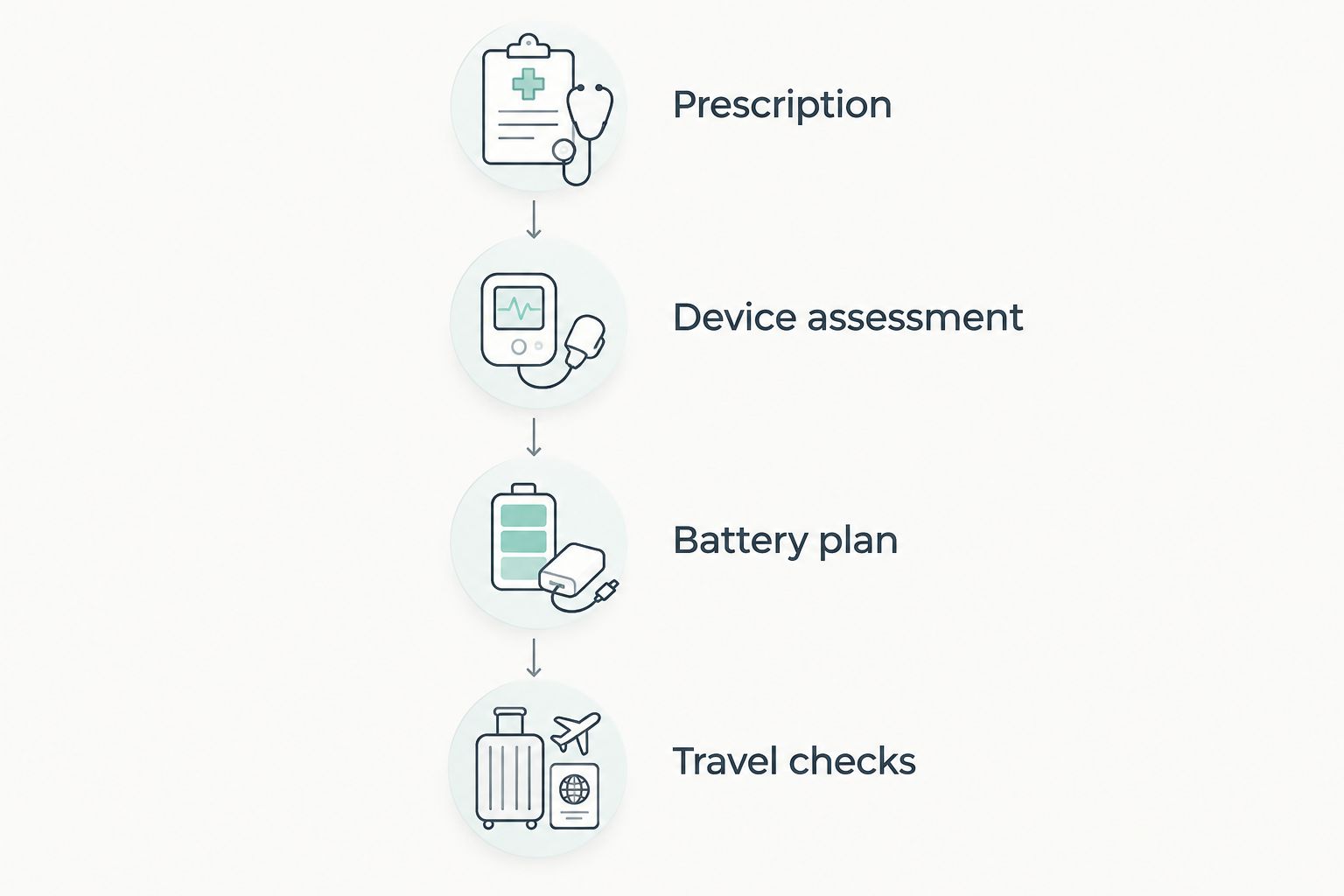
Use this sequence with your oxygen provider. The goal is to eliminate an unsuitable device before spending time comparing carrying cases or chargers.
- Prescription: Confirm the required delivery mode and settings for rest, activity, and sleep.
- Device assessment: Check the exact concentrator under the conditions in which you intend to use it.
- Battery plan: Establish endurance at those settings and arrange the required reserve.
- Travel checks: Confirm airline requirements, power arrangements, and a backup plan.
The assessment must concern the actual model you intend to carry. A successful trial with a different concentrator does not establish that another device's pulse delivery will work identically for you.
Build a battery plan around your itinerary
For a 2026 flight, ask the operating airline about its portable oxygen concentrator process before departure. Under U.S. Department of Transportation rules, an airline can require enough fully charged batteries for at least 150% of the expected maximum flight duration.
That rule is not a promise of power at your seat. Plan for ground transfers, check-in, boarding, delays, and the period after landing as well as the flight itself.
- Identify the exact battery configuration used for the runtime estimate.
- Use runtime at your prescribed setting and delivery mode.
- Follow airline and battery-safety rules for carrying spare batteries.
- Protect spare battery terminals against short circuits.
- Confirm whether the device can operate and charge from your intended power source.
Do not improvise adapters or assume a vehicle outlet provides suitable power. Follow the concentrator manufacturer's power-supply instructions.
Keep oxygen safety in the travel plan
Oxygen supports combustion. Keep oxygen equipment away from smoking, flames, and other ignition sources, and follow the manufacturer's clearance and ventilation instructions.
Do not place a running concentrator in a closed suitcase or cover its intake. If your condition changes or the prescribed setup no longer maintains your clinician's oxygen target, seek medical advice rather than adjusting settings by guesswork.
Portable travel oxygen versus a destination concentrator
A machine that you can move between locations is not automatically a battery-powered travel concentrator. Distinguish equipment used during the journey from equipment used after arrival.
Ewot lists the Drive DeVilbiss 5 LPM Oxygen Concentrator and the Drive DeVilbiss 10 LPM Oxygen Concentrator. Those product names are not evidence of onboard battery operation or airline acceptance; do not treat either listing as a substitute for a verified travel setup.
Ewot is best suited to shoppers exploring at-home wellness equipment, not to determining a travel oxygen prescription. For medical oxygen at your destination, arrange an appropriate device with your oxygen provider and confirm delivery, power, and backup arrangements before departure.
The advantage of a destination arrangement is that journey and overnight requirements can be planned separately. The limitation is that you still need suitable oxygen support during every transfer between them.
How these concentrators were ranked
This ranking prioritizes prescribed delivery mode, published continuous-flow limits, and transport format. It is a specification-based selection guide, not a head-to-head clinical trial or a battery endurance test.
The model distinctions follow the Inogen Rove 6 User Manual, Philips Respironics SimplyGo User Manual, and CAIRE Eclipse 5 User Manual. These sources describe device operation; your clinician determines medical suitability, and your airline determines its travel procedures.
For your 2026 purchase decision, confirm the current manual for the exact model and battery configuration. Do not use a retailer's category label as evidence of clinical suitability or flight acceptance.
Which travel oxygen concentrator should you choose?
Choose Inogen Rove 6 as the starting point only when pulse-dose delivery meets your assessed needs. Choose Philips Respironics SimplyGo when you need continuous flow up to 2 L/min; choose CAIRE Eclipse 5 when the prescribed continuous flow exceeds 2 L/min but does not exceed 3 L/min.
If none fits your prescription, skip the shortlist. The correct next move is an oxygen-provider assessment—not a compromise on delivery mode or flow.
FAQ
What's the best portable oxygen concentrator for travel in 2026?
The best choice is the device that meets your prescribed oxygen requirements throughout the trip. Inogen Rove 6 suits assessed pulse-dose needs; Philips Respironics SimplyGo and CAIRE Eclipse 5 offer continuous flow within their respective limits.
Is a pulse-dose setting the same as liters per minute?
No. A pulse-dose setting is not equivalent to a continuous-flow rate in liters per minute. Your clinician must assess the exact device and setting rather than match the numbers.
Which shortlisted concentrator provides continuous flow?
Philips Respironics SimplyGo provides continuous flow up to 2 L/min, and CAIRE Eclipse 5 provides continuous flow up to 3 L/min. Inogen Rove 6 does not provide continuous flow.
Can I take a portable oxygen concentrator on an airplane?
You can travel with a qualifying portable oxygen concentrator when you meet the applicable airline and aviation requirements. Confirm your exact device, battery reserve, notification process, and any required documentation with the operating airline.
How many batteries should I take for a flight?
Calculate your battery needs from your prescribed setting, the exact battery configuration, and the airline's requirements. U.S. airlines can require enough fully charged batteries for at least 150% of the expected maximum flight duration; also plan for oxygen use before and after the flight.
Can I sleep with the same concentrator I use while walking?
Use a concentrator during sleep only when your clinician has assessed and approved that device and setting for overnight use. Daytime suitability does not establish overnight suitability.
Can an exercise-with-oxygen system replace my medical travel oxygen?
No. An exercise-with-oxygen wellness setup is not a substitute for prescribed medical travel oxygen. Keep your wellness equipment decision separate from your clinician-directed oxygen plan.
One last thing
Rehearse the whole trip, not just switching on the machine. Carry the batteries and charger, practice the vehicle transfer, and check that a travel companion knows the alarms and backup arrangements. Finding a handling problem at home is better than discovering it at the boarding gate.
