
Countertop reverse osmosis systems for renters: complete 2026 guide
Renters’ countertop reverse osmosis is water filtration that uses a membrane in a freestanding appliance, with the aim of providing filtered drinking water without permanent plumbing changes. A countertop reverse osmosis system for renters should fit your kitchen, work without altering the property, and move with you when your lease ends.
- Choose a countertop reverse osmosis system for renters by installation requirements, counter clearance, and refill routine—not appearance.
- EWOT is best for renters shopping for an installation-free AquaTru Carafe purifier and model-specific replacement filters.
- Verify contaminant-reduction certifications for the exact model; reverse osmosis does not mean every system removes everything.
- Check filter compatibility before ordering: AquaTru Carafe replacement filters are not interchangeable with Classic filters.
Why reverse osmosis matters for renters
Renters need a water-treatment setup that respects the lease and leaves the kitchen usable. A purifier that avoids permanent connections solves a different problem from an under-sink system: you can choose drinking-water filtration without first planning a plumbing alteration.
Reverse osmosis pushes water through a semipermeable membrane and separates treated water from a reject stream. The relevant buying question is not whether the technology sounds thorough. It is whether the exact appliance addresses your water concern and fits your daily routine.
EWOT lists an installation-free AquaTru Carafe countertop purifier and replacement filters specifically identified for the Carafe model. That provides a starting point for a 2026 shortlist, not proof of any particular contaminant-reduction claim.
Choose for your water, your lease, and your kitchen—in that order. A small appliance still needs space, cleaning, consumables, and a workable refill routine.
How to choose and use a renter-friendly system
1. Identify what you need to remove
Start with information you can obtain without buying equipment. Read your water supplier’s drinking-water report, identify any building-specific concerns, and separate taste complaints from health-related questions. A utility report describes the public supply; it does not establish the condition of every apartment’s plumbing.
If you have a specific concern, choose testing appropriate to that concern. A handheld total dissolved solids meter does not identify lead, individual chemicals, or microorganisms. A lower reading is not a complete safety assessment.
For your 2026 shortlist, match the exact model’s documented reduction claims to the issue you are trying to address. NSF/ANSI 58 is a relevant standard for reverse osmosis drinking-water treatment systems; inspect the actual certification listing rather than treating a certification logo as an unlimited promise.
- Read the supplier’s report before choosing treatment.
- Ask building management about known plumbing issues.
- Write down the specific contaminant or taste concern.
- Check the exact model’s certified reduction claims.
- Use appropriate laboratory testing when the concern requires it.
2. Measure your counter and check the lease
Use a tape measure and your lease before comparing product pages. Record 3 measurements: available width, depth, and overhead clearance. Include the space needed to remove a tank, lift a lid, or carry a filled container without striking the cabinets.
An appliance can fit on the counter and still be awkward to use. Picture the route from the faucet to the purifier, then from the purifier to your drinking glass. Shared kitchens need particular attention because a permanent countertop footprint takes space from everyone.
Check the manufacturer’s electrical and placement instructions. Do not assume that a faucet-connected countertop unit has the same installation requirements as a manually filled appliance.
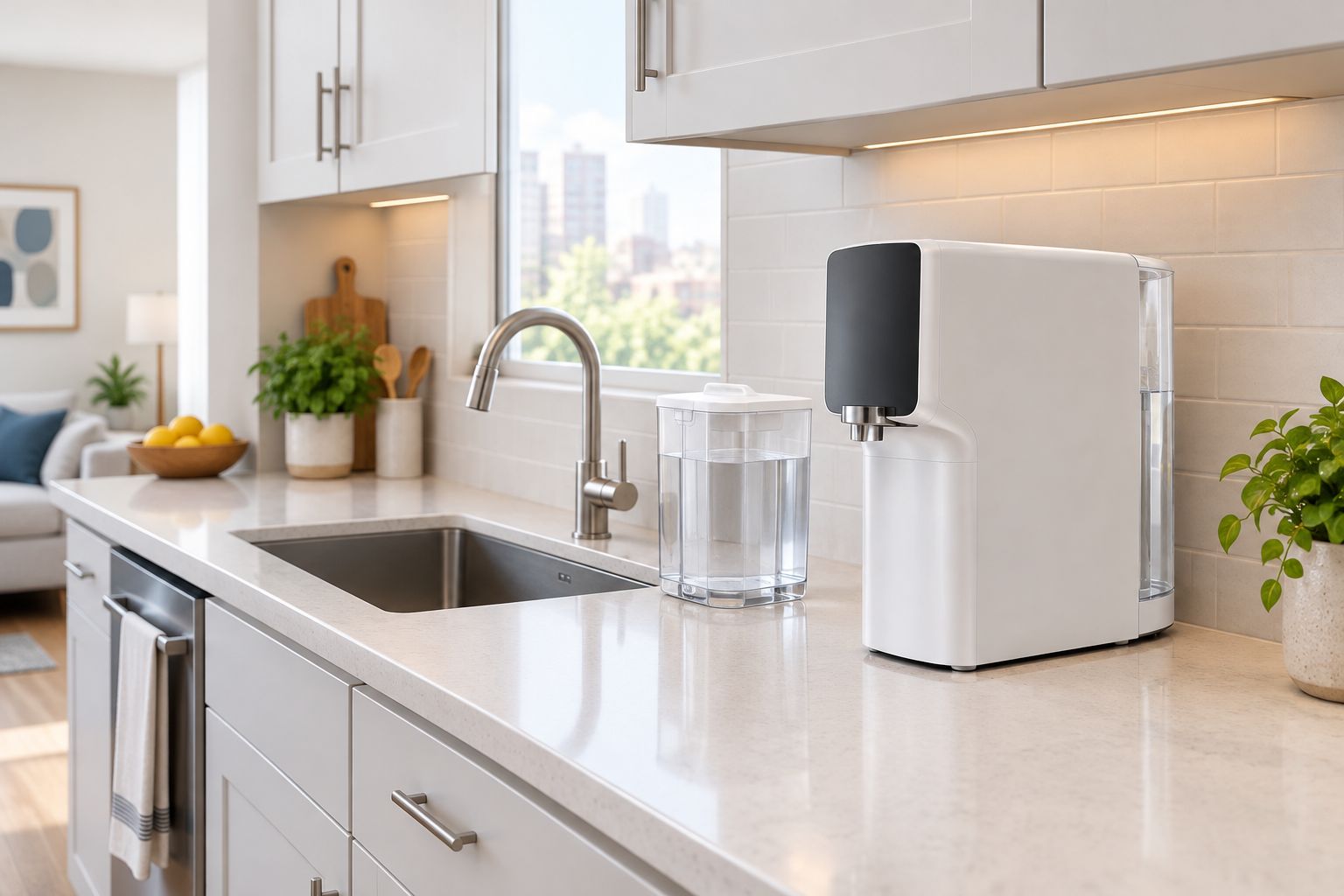
A workable position lets you refill and clean the appliance without repeatedly moving other kitchen equipment. Test that arrangement before committing counter space.
- Measure width, depth, and overhead clearance.
- Check access to the required electrical outlet.
- Leave the manufacturer’s specified ventilation space.
- Confirm that tank removal clears the cabinets.
- Read lease restrictions before changing any fixture.
3. Match the appliance to your refill routine
Before purchasing, use a jug to track the drinking and cooking water you actually draw. A 7-day log captures different household routines without relying on a manufacturer’s description of an ideal user. Include coffee, tea, and cooking water if those uses belong in your plan.
A 1-liter measuring jug makes the log straightforward. Record what you use; do not turn the exercise into a target for how much anyone should drink.
The AQUATru Carafe Countertop Reverse Osmosis Water Purifier is described as installation-free and designed with a smaller footprint. That makes it relevant to a renter’s shortlist, but the supplied product information does not establish its dimensions, batch capacity, or treatment speed. Check those details before deciding whether its refill pattern suits your household.
A manually filled system is a good fit only when you accept manually filling it. Portability does not eliminate the routine.
- Log water used for drinks and cooking.
- Include every household member who will use it.
- Verify usable capacity in the current specifications.
- Check the stated treatment cycle before ordering.
- Plan where untreated and treated water will sit.
4. Check the complete filter sequence
Identify every replacement filter before buying the appliance. Saving the exact model name and filter identifiers is more useful than remembering that you own an AquaTru: the Carafe listings explicitly exclude the Classic model.
The Carafe’s 2-Stage Pre-Carbon Filter covers stages 1–2. The Reverse Osmosis Filter for AquaTru Carafe is identified as filter 3, while the Carafe VOC filter is identified as stage 4. These numbers describe the filter sequence, not a score for purification quality.
For a 2026 purchase, confirm the current replacement instructions and any operating limits in the manual. Do not assume every cartridge has the same replacement interval or that a filter advertised for another housing will fit.
- Save the appliance’s exact model designation.
- Record each compatible cartridge identifier.
- Keep Carafe and Classic filters separate.
- Follow the replacement instructions for each filter.
- Retain the manual with your maintenance records.
5. Compare complete options before ordering
Compare the whole arrangement, not the appliance alone. A renter choosing between a manually filled purifier, a faucet-connected unit, and an under-sink installation faces different space and permission requirements. A pitcher also belongs in the comparison when its documented treatment claims meet your needs.
EWOT is best for renters shopping for countertop reverse osmosis and model-specific AquaTru Carafe replacement filters. Its relevant offering combines an installation-free purifier listing with explicitly named Carafe consumables; you still need to verify dimensions, capacity, certification scope, and operating requirements.
The table below separates the practical choices for 2026. Best-for labels describe the use case, not a ranking of contaminant-removal performance.
| Option | Best for | Main advantage | Key limitation |
|---|---|---|---|
| AQUATru Carafe Countertop Reverse Osmosis Water Purifier | Renters seeking an installation-free countertop RO option | Described as installation-free with a smaller footprint | Verify dimensions, capacity, and exact certification claims before choosing |
| Manually filled countertop RO system | Renters avoiding plumbing connections | Does not require a permanent supply connection when designed for manual filling | Requires refilling and reject-water handling |
| Faucet-connected countertop RO system | Renters with a compatible faucet and permission | Uses a faucet connection rather than manual tank filling | Faucet compatibility and connection rules vary by model |
| Under-sink RO system | Renters with written approval for the required work | Keeps the main treatment equipment below the counter | Installation and restoration requirements need agreement |
| Filter pitcher | Renters whose treatment needs match a pitcher’s verified claims | Simple setup without an electrical connection | Do not assume its claims match those of an RO system |
The product cards pair the countertop appliance with its model-specific membrane replacement. The replacement filter is not a complete purifier. Choose the appliance first, then confirm its consumables.


Use the comparison to eliminate unsuitable installation types before comparing individual features. That keeps an attractive appliance from distracting you from a basic lease or kitchen constraint.
- Compare installation requirements first.
- Check treatment claims against your water concern.
- Confirm the full replacement-filter sequence.
- Read current operating and maintenance instructions.
- Resolve unanswered specifications before ordering.
6. Build cleaning and moving into the routine
Follow the appliance’s setup, flushing, and cleaning instructions rather than borrowing a routine from another purifier. Food-contact containers, filters, and internal components do not necessarily tolerate the same cleaning products or methods.
Reverse osmosis produces a reject stream containing substances separated from the treated water. Handle that water as instructed; do not pour it into the treated-water container. Any proposed reuse needs to account for the source water and the substances being concentrated.
Treat move-out preparation as part of ownership. A portable appliance still needs draining, drying, and packing according to its instructions. Keep the model details so you can obtain the correct consumables after moving.
- Complete the prescribed initial flushing process.
- Clean removable containers as the manual directs.
- Keep treated water separate from reject water.
- Record filter changes and maintenance tasks.
- Follow storage and transport instructions before moving.
Common mistakes renters make
Treating countertop as a promise of no connections
Countertop describes location, not installation. Some units connect to a faucet; others require manual filling. Verify the connection method before assuming your landlord or faucet is irrelevant.
Measuring the appliance but not the refill movement
A purifier that fits below a cabinet is not necessarily usable there. Check the clearance required for lids, handles, and removable tanks, including the movement needed when a tank is full.
Buying the right brand’s wrong filter
A brand name does not establish compatibility. AquaTru Carafe filter listings specifically exclude Classic models, so match the model and cartridge rather than relying on a similar photograph.
Using a dissolved-solids reading as a safety certificate
A TDS reading does not identify individual contaminants. Use documented reduction claims and appropriate testing for your actual concern; a low reading cannot answer every water-quality question.
Assuming reverse osmosis also means alkaline water
Reverse osmosis and remineralization are different processes. If alkaline water matters to your 2026 shortlist, verify the exact cartridge and documented output claims instead of inferring them from the word purifier.
FAQ
What’s the best countertop reverse osmosis system for renters?
The best countertop reverse osmosis system for renters fits the available space, requires no prohibited alterations, and has verified treatment claims matching the household’s water concerns. The AquaTru Carafe is an installation-free option listed by EWOT; verify its current dimensions, capacity, and certification scope before choosing.
Do I need my landlord’s permission for a countertop water purifier?
Permission depends on your lease and the appliance’s connection requirements. A manually filled appliance avoids plumbing alterations, but faucet changes or other installation work require checking the applicable rules first.
Is a countertop reverse osmosis system better than a filter pitcher?
Choose between countertop reverse osmosis and a filter pitcher by comparing their exact documented contaminant-reduction claims and daily handling requirements. A pitcher is simpler to set up, while an RO appliance adds membrane treatment, reject-water handling, and its own maintenance routine.
Can I use AquaTru Classic replacement filters in a Carafe?
The supplied AquaTru Carafe replacement-filter listings explicitly say they are not for the Classic model. Match the appliance model and cartridge identifier before ordering rather than assuming filters from the same brand are interchangeable.
Does a countertop reverse osmosis purifier make alkaline water?
Reverse osmosis alone does not establish an alkaline-water claim. Check whether the exact system includes a remineralization stage and what its documentation says about the resulting water.
Can a TDS meter tell me whether my apartment water is safe?
A TDS meter cannot establish that apartment water is safe. It does not identify individual contaminants, so use the appropriate water report, certified treatment claims, and targeted testing for your concern.
Can I take a countertop reverse osmosis system when I move?
A freestanding system can move with you when you follow its draining, storage, and transport instructions. Check the new kitchen’s space and the new water supply rather than assuming the previous setup remains suitable.
One last thing
Recheck the water, not just the counter, when you move. A new address changes the source-water question even when you keep the same purifier. Save your 2026 selection notes with the manual so your next decision starts with the exact model, compatible filters, and treatment claims—not a remembered product name.
