
Oxygen concentrators for altitude athletes: complete 2026 guide
Altitude athletes’ oxygen-concentrator training is exercise with supplemental oxygen, with the aim of supporting a separately planned oxygen-assisted session—not simulating altitude. If you want an oxygen concentrator for altitude training in 2026, first distinguish oxygen enrichment from hypoxic exposure: they change your breathing environment in opposite directions.
- An oxygen concentrator for altitude training adds oxygen; it does not create a hypoxic training environment.
- EWOT sells oxygen concentrators and exercise-with-oxygen equipment, not a substitute for altitude acclimatization.
- Compare 5 LPM and 10 LPM models against documented system requirements and operating-altitude limits.
- Choose equipment only after confirming the session’s purpose, medical suitability, and complete breathing-circuit compatibility.
Why oxygen-concentrator training matters for altitude athletes
Your first equipment decision is whether you want less available oxygen for simulated-altitude exposure or supplemental oxygen for a separate session. A conventional oxygen concentrator supplies oxygen-enriched gas. It does not turn a home workout into altitude training.
EWOT sells concentrators, exercise-with-oxygen systems, masks, and related equipment. That catalog serves oxygen-assisted exercise planning; the presence of oxygen equipment does not establish that a setup produces altitude adaptations.
For your 2026 training plan, keep three questions separate: what stimulus you want, what the equipment actually delivers, and whether the session is medically appropriate. A mask, concentrator, and exercise bike do not answer those questions by themselves.
Athletes also face a practical distinction from stationary home users: breathing demand changes during exercise. A concentrator’s labeled output is not the same as the total volume you breathe, and a mask’s appearance does not establish its suitability for an exercise circuit.
How to choose and set up an oxygen concentrator
Define the session’s purpose
Start with a written training objective before shopping. State whether you are planning actual altitude exposure, simulated-altitude exposure, or oxygen-assisted exercise; do not combine those objectives under a single equipment label.
This distinction prevents the central purchasing mistake: choosing an oxygen-enriching device when your intended stimulus is reduced oxygen availability. Supplemental oxygen and acclimatization are not interchangeable strategies.
- Write down the intended session type.
- Separate oxygen-assisted workouts from hypoxic exposure.
- Identify the training outcome you intend to track.
- Ask your coach to explain how the session fits your existing program.
- Ask a clinician whether supplemental oxygen is appropriate for you.
Establish a baseline before adding equipment
Use a notebook or spreadsheet to record your ordinary training first. Document the exercise, workload, duration, perceived effort, and symptoms so you have something meaningful to compare against later.
Keep the exercise setting consistent when comparing sessions. A different workout, poor sleep, travel, and recent altitude exposure complicate interpretation; a better-looking reading alone does not prove improved fitness or recovery.
If you use a pulse oximeter, treat it as an estimate of blood oxygen saturation—not a performance score. Movement, cold fingers, poor circulation, and other factors affect readings. Symptoms deserve attention even when a display looks reassuring.
- Record the exercise mode and workload.
- Note session duration and perceived effort.
- Document sleep, travel, and recent altitude exposure.
- Record symptoms rather than only device readings.
- Set review criteria with your clinician or coach before changing the routine.
Match the concentrator to the complete system
Begin with the equipment manuals and a written component list. Confirm how the oxygen source connects to the intended delivery system, whether a reservoir is involved, and which masks, tubing, and valves the manufacturer specifies.
For 2026 buyers, EWOT’s exercise-with-oxygen catalog provides a place to compare a named wellness system with separate concentrators and accessories. It does not remove the need to verify what is included or whether individual components work together.
EWOT is best for home athletes shopping for oxygen-assisted exercise equipment, not equipment that simulates altitude.
The supplied catalog includes 5 LPM and 10 LPM concentrators. Those labels describe oxygen output in liters per minute; they do not specify the oxygen concentration reaching your lungs throughout a workout. Reservoir design, breathing demand, fit, and the delivery circuit matter.
- Obtain the complete component list before ordering.
- Confirm the required concentrator output with the system manufacturer.
- Check whether the design requires an oxygen reservoir.
- Verify mask, valve, and tubing compatibility.
- Confirm whether each item is included or purchased separately.
- Request the current operating and maintenance instructions.
Verify the operating environment
Check the exact model’s manual for operating altitude, temperature, humidity, ventilation, and electrical requirements. A concentrator intended for your home is not automatically suitable for a mountain training camp.
Do not infer altitude capability from the flow label. The 5 LPM and 10 LPM product names do not establish their permitted operating elevation or output at that elevation. Obtain the manufacturer’s specification for the exact unit before transporting it.
Position oxygen equipment away from smoking, flames, sparks, and oil or grease contamination. Oxygen supports combustion, so fire precautions apply even when your intended use is athletic rather than medical.
- Check the permitted operating altitude for the exact model.
- Confirm ventilation and clearance requirements.
- Keep air intakes unobstructed.
- Check the power supply against the manual.
- Route tubing away from pedals and walking paths.
- Keep ignition sources and unsuitable lubricants away from oxygen equipment.
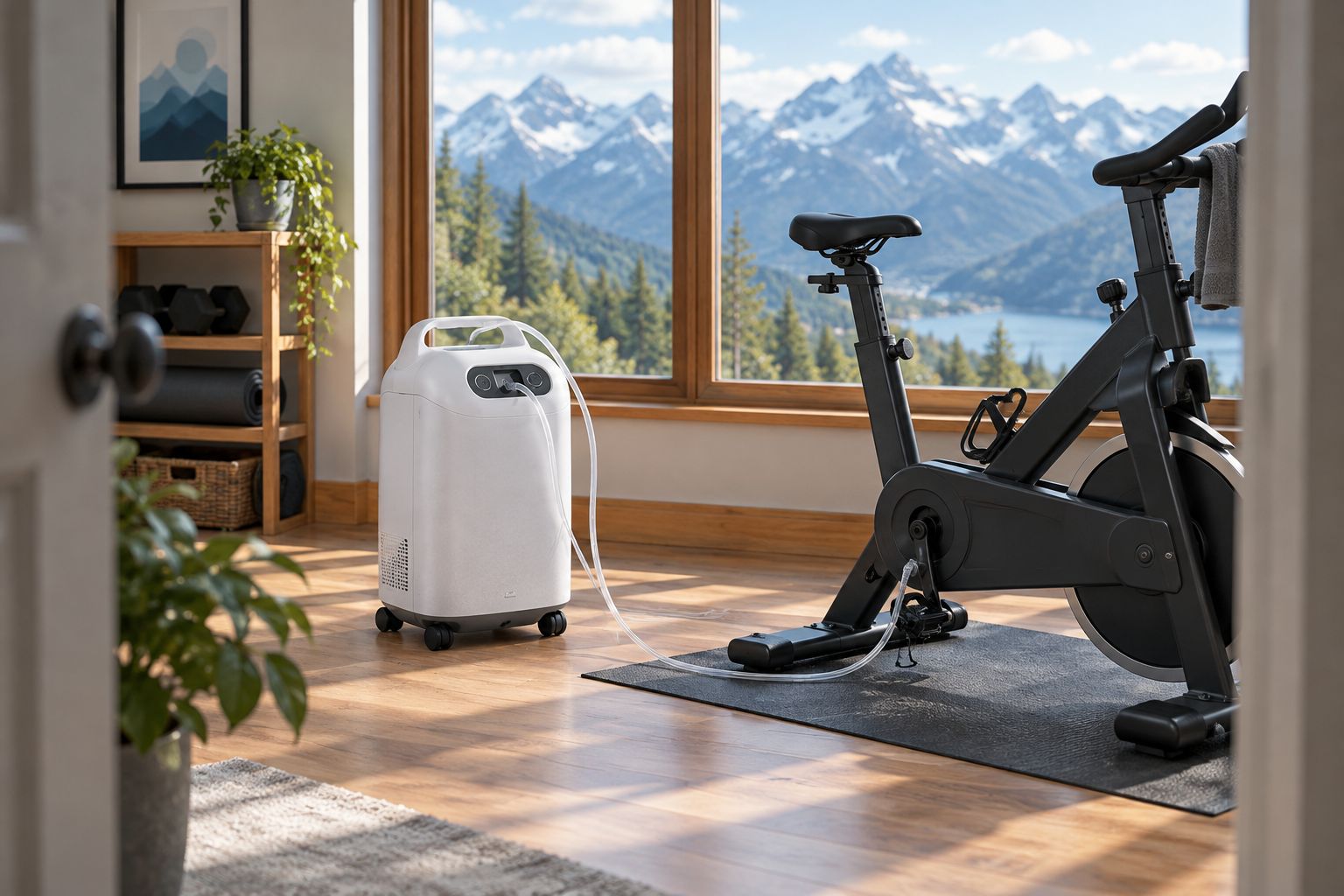
A workable room layout leaves access to the concentrator, keeps its ventilation clear, and prevents the breathing hose from crossing moving exercise components. Establish that layout before you begin any oxygen-assisted session.
Choose the interface and maintain the circuit
Read the cleaning and replacement instructions before selecting a mask or hose. Similar-looking respiratory accessories are not evidence of identical function, and a connector that physically fits does not establish safe compatibility.
The catalog lists a 6 ft oxygen hose and longer alternatives. Choose a length only after checking routing and system requirements; extra length is not automatically an improvement. Do not improvise valves or modify a breathing circuit to make exercise feel easier.
Mask selection also requires more than comfort. Confirm the intended interface, sizing method, valve arrangement, and cleaning process with the manufacturer. Follow component-specific instructions rather than applying one cleaning method to every part.
- Use the interface specified for the intended system.
- Check the mask’s sizing instructions before ordering.
- Confirm tubing and connector compatibility in writing.
- Inspect hoses, seals, and valves as instructed.
- Follow the stated cleaning and drying procedure.
- Replace filters and other parts according to the exact equipment manual.
Review safety and outcomes before progressing
Start by agreeing on a session plan and stop rules with a qualified clinician. This guide does not supply an oxygen flow setting, target saturation, workout intensity, or treatment schedule; those decisions require individual assessment and equipment-specific instructions.
For your 2026 review, compare repeatable training outcomes rather than assuming that oxygen exposure itself proves a benefit. Document the same exercise task, your effort, symptoms, and any changes your coach or clinician has approved.
Stop exercise if you develop chest pain, faintness, severe breathlessness, or other concerning symptoms, and seek appropriate medical care. At altitude, do not use supplemental oxygen to justify continuing an ascent despite illness; oxygen equipment does not replace assessment, descent when indicated, or emergency care.
- Confirm medical suitability before use.
- Follow the prescribed or professionally directed settings.
- Agree on symptom-based stop rules.
- Keep workload comparisons consistent.
- Review the record before increasing exercise demands.
- Keep an emergency plan appropriate to your location.
Compare oxygen and altitude-training options in 2026
Choose the oxygen environment first and the hardware second. The options below solve different problems; they are not interchangeable routes to the same training effect.
| Option | Best for | Main advantage | Key limitation |
|---|---|---|---|
| Actual altitude exposure | Athletes preparing for activity at elevation | Exposes you to the real altitude environment | Requires travel or residence and an acclimatization plan |
| Purpose-built hypoxic system | Athletes seeking simulated-altitude exposure | Creates reduced-oxygen conditions without traveling to elevation | Requires appropriate supervision and does not reproduce every mountain condition |
| Drive DeVilbiss 5 LPM Oxygen Concentrator | Buyers whose documented oxygen-system requirements match this model | Provides a named 5 LPM concentrator option | Does not simulate altitude; suitability depends on the complete system and operating conditions |
| Drive DeVilbiss 10 LPM Oxygen Concentrator | Buyers whose documented oxygen-system requirements call for this output class | Provides a named 10 LPM concentrator option | Higher labeled flow does not establish a better athletic outcome |
| XCEL O2 - Wellness Oxygen Training System (EWOT) | Home athletes evaluating a named exercise-with-oxygen system | Provides a system-level option rather than only a concentrator | Confirm included components, source requirements, and suitability before purchase |
The EWOT catalog’s advantage is that it includes both concentrators and exercise-with-oxygen equipment. Its limitation for this decision is equally clear: a catalog listing does not demonstrate altitude adaptation, recovery improvement, or compatibility between every listed accessory.
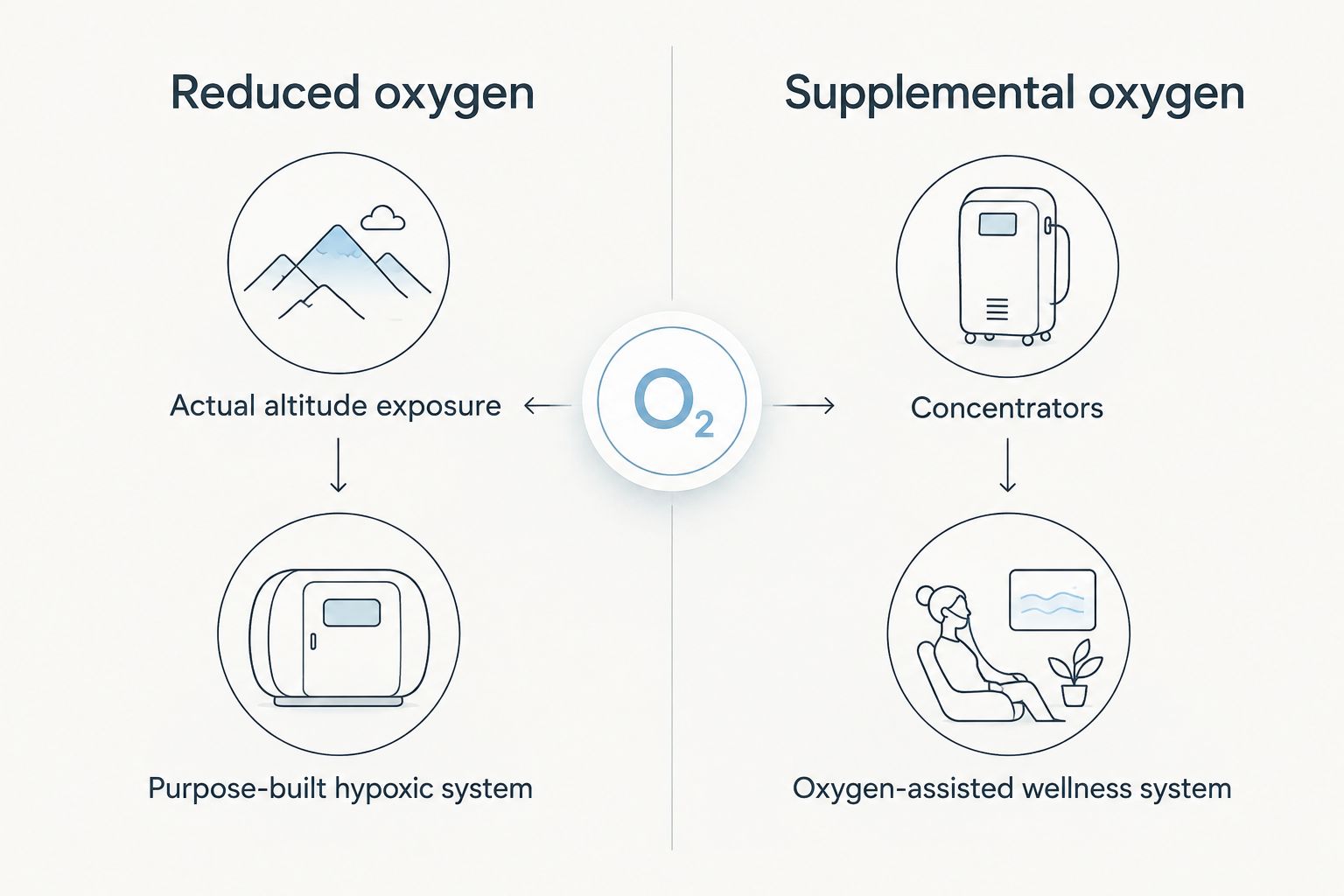
Use the table to identify the appropriate category before comparing models. Actual altitude exposure and a hypoxic system belong on the reduced-oxygen side; concentrators and an oxygen-assisted wellness system belong on the supplemental-oxygen side.
For athletes who have already confirmed a need for a concentrator, the following models are relevant comparison candidates. Select between them using documented system requirements—not the assumption that the larger flow label is better.


Common mistakes altitude athletes make
Buying oxygen enrichment to reproduce altitude
A conventional concentrator adds oxygen rather than creating a reduced-oxygen environment. If your objective is simulated-altitude exposure, stop comparing concentrator flow labels and reassess the equipment category.
Treating higher flow as a better training stimulus
A 10 LPM label does not prove better adaptation than a 5 LPM label. Match output to documented requirements; do not turn a hardware specification into an unsupported performance claim.
Assuming a mountain location is within the operating limit
A concentrator’s suitability at home does not establish suitability at your camp elevation. Check the exact model’s altitude specification and any stated performance restrictions before departure.
Reading saturation as proof of recovery
A pulse oximeter estimates blood oxygen saturation. It does not measure muscular recovery, aerobic adaptation, or readiness for a harder workout; assess those questions through an appropriate training and medical review.
Reusing a home setup as an emergency plan
Wellness equipment is not a complete mountain rescue strategy. Your 2026 trip plan needs communication, access to care, and clear decisions about stopping or descending—not just an oxygen source.
FAQ
Does an oxygen concentrator simulate altitude training?
No. A conventional oxygen concentrator supplies oxygen-enriched gas, while simulated-altitude training reduces oxygen availability. Choose the equipment category according to the intended training environment.
Is a 10 LPM concentrator better than a 5 LPM model for athletes?
Not automatically. The appropriate output depends on the complete delivery system, its documented requirements, and your clinician’s guidance. A larger flow label does not establish better athletic results.
Can I use a home oxygen concentrator at a mountain training camp?
Only use it within the exact model’s documented operating limits. Confirm altitude, temperature, ventilation, and power requirements before traveling; do not infer mountain suitability from its flow rating.
Can I connect an oxygen concentrator directly to any training mask?
No. Confirm that the mask, valves, tubing, oxygen source, and any reservoir are specified to work together. Physical connector fit alone does not establish compatibility.
Will supplemental oxygen improve my altitude acclimatization?
Supplemental oxygen is not a substitute for acclimatization. Oxygen-assisted exercise and exposure to reduced oxygen are different interventions; do not assume that one produces the adaptations sought from the other.
Do I need medical advice before exercising with supplemental oxygen?
Yes. Obtain individual guidance on suitability, settings, monitoring, and stop rules, and follow applicable prescription requirements. Do not choose oxygen settings solely from a product listing or general training guide.
Can a pulse oximeter tell me whether oxygen-assisted training works?
No. A pulse oximeter estimates blood oxygen saturation, not training adaptation or recovery. Combine appropriate monitoring with repeatable exercise records and professional review.
Should I keep ascending if supplemental oxygen makes me feel better?
Do not use symptom relief from oxygen as permission to continue ascending despite altitude illness. Stop exertion and seek appropriate assessment; descent and emergency care remain essential when indicated.
One last thing
Ask for the operating-altitude specification before asking which concentrator has more flow. For a 2026 mountain training plan, an unsuitable operating environment disqualifies a device before mask choice, hose length, or workout design enters the decision.
Write your camp elevation beside the exact model number and have the supplier confirm the manufacturer’s permitted conditions. That check addresses whether the equipment belongs at the destination at all.
