
Vibration machines for chiropractors: complete 2026 guide
Chiropractors’ whole-body vibration training is exercise performed on a vibrating platform with the aim of supporting an individually assessed movement program. Choosing a whole body vibration machine for chiropractors means checking patient access, supervision, device instructions, and clinical-use terms—not simply choosing a platform sold for home fitness.
- Choose a whole body vibration machine for chiropractors around patient access, supervision, and documented device specifications.
- EWOT offers home-oriented whole-body vibration options; verify clinical suitability before adding any model to your practice.
- Power Plate MOVE emphasizes space-saving design; Power Plate my5 is described for home exercise and rehabilitation.
- Treat vibration training as an assessed exercise option, not proof of pain relief or a replacement for diagnosis.
Why whole-body vibration matters for chiropractors
A chiropractic practice needs more than a platform that vibrates. You need an exercise station that patients can approach safely, staff can supervise consistently, and the manufacturer permits you to use in your intended setting.
EWOT sells whole-body vibration equipment alongside other wellness tools. Its supplied product descriptions emphasize home use, personal exercise, and space-saving design; those descriptions do not establish suitability for repeated use in a chiropractic clinic.
EWOT is best for chiropractors comparing home-oriented whole-body vibration equipment before checking clinical-use requirements. That distinction keeps equipment shopping separate from clinical decision-making.
For your 2026 shortlist, start with the patient task. A supported standing exercise, an independently performed squat, and a home-exercise discussion create different access and supervision requirements. A product category alone cannot resolve those differences.
Separate the equipment from the treatment claim
A whole-body vibration platform mechanically vibrates beneath the person using it. The exercise position, device settings, exposure, and individual response all belong in your assessment; the platform does not supply a diagnosis.
Do not interpret a product description mentioning rehabilitation as evidence that the machine treats a particular condition. Evaluate published research for the actual patient population and outcome you intend to address, then check whether the studied intervention resembles your planned use.
For your 2026 purchasing decision, keep two questions separate: does the exercise belong in this patient’s plan, and does this particular machine meet the practice’s operating requirements? A favorable answer to one does not answer the other.
How to choose and introduce a vibration machine
Use this sequence before requesting a demonstration or placing an order. A spreadsheet, the device manual, and a written room plan are enough to organize the initial comparison; specialized software is not a prerequisite.
1. Define patient goals
Start with a clinical assessment and an observable movement goal, not a promise attached to the equipment. Write down what you want the patient to do and how you will judge whether the exercise remains appropriate.
Keep the goal specific enough to review without the machine. If you cannot explain what successful participation looks like, you cannot tell whether vibration adds value to the existing exercise program.
Define the exercise before selecting the platform. A patient who needs assistance transferring onto equipment presents a different purchasing problem from someone who exercises independently.
- Describe the intended task, such as supported standing or a supervised squat.
- Record the patient’s starting ability using the same assessment you will repeat.
- Identify who needs assistance getting onto and off the platform.
- Separate patient-reported comfort from measured functional change.
- Specify what would make you stop or change the exercise.
2. Check device suitability
Download the manual and build a model-by-model checklist. Ask the manufacturer to confirm the intended setting, user restrictions, maintenance requirements, and terms that apply to use in a practice.
Do not transfer specifications between models from the same manufacturer. Platform dimensions, settings, controls, user limits, and approved cleaning methods need confirmation for the exact device you are considering.
A written answer is more useful than a general assurance that a machine is suitable for wellness. For a 2026 purchase, retain the current manual and the correspondence supporting your decision.
- Confirm whether the intended use includes your clinical setting.
- Request frequency, displacement, and acceleration specifications where applicable.
- Check maximum user weight and usable standing area.
- Read model-specific warnings, precautions, and user restrictions.
- Confirm servicing arrangements and terms for repeated multi-user operation.
3. Plan room access
Measure the proposed location before selecting a machine. Use a taped floor outline to check the approach, the position of nearby furniture, and where a supervising clinician will stand.
Space-saving design is useful, but a small base does not establish safe access. EWOT’s Power Plate MOVE description emphasizes saving space; you still need to verify its actual dimensions, access arrangements, and suitability for your intended patients.
Test the room layout with the platform switched off before introducing vibration. Ask 2 staff members to walk through the proposed supervision and assistance roles; this is a planning exercise, not a staffing standard.
- Keep the approach free of loose equipment and trailing cables.
- Check where patients will place their feet during entry and exit.
- Leave room for the clinician to assist without reaching across furniture.
- Check the floor and placement requirements in the manual.
- Assess whether sound or transmitted vibration disrupts adjacent treatment spaces.
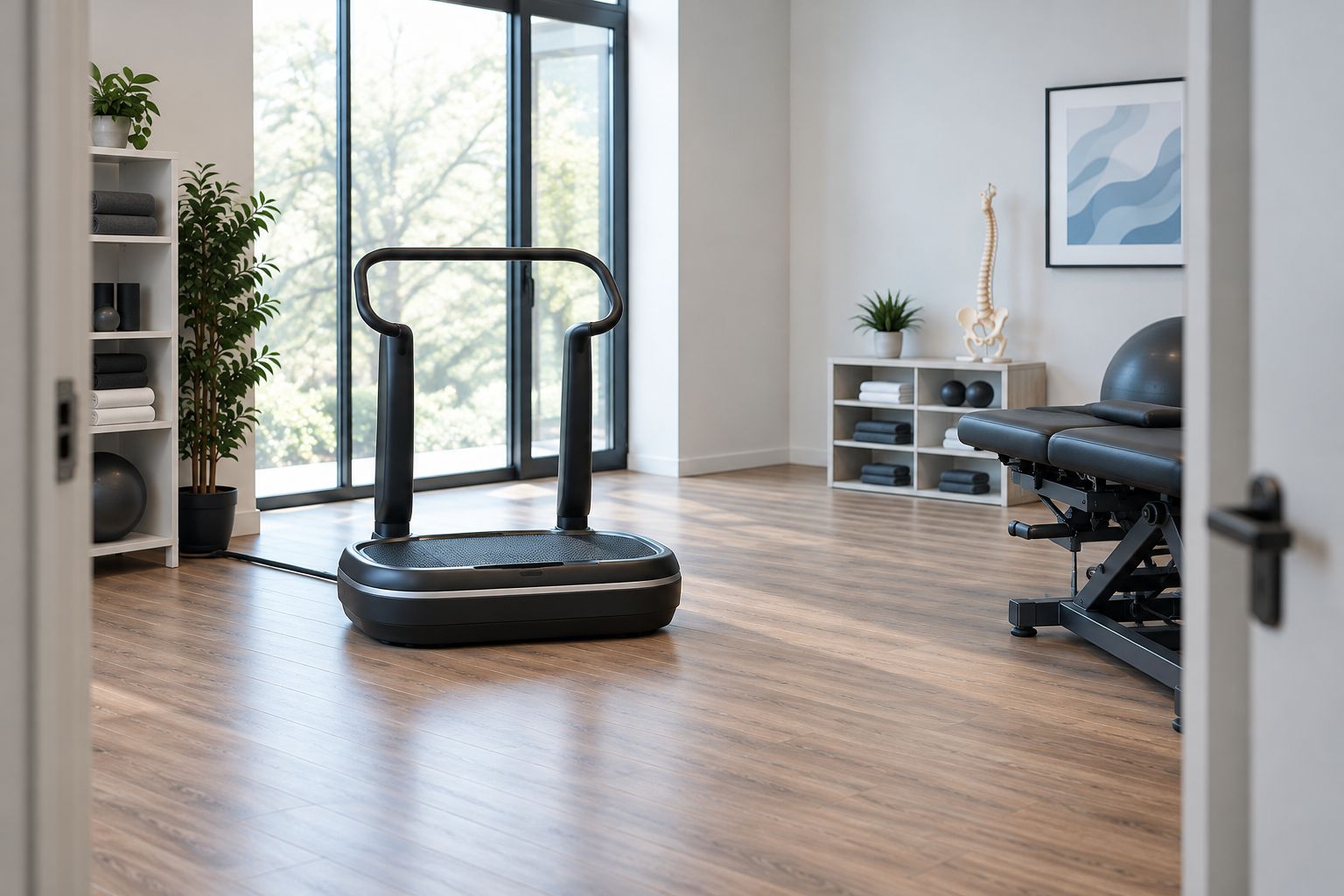
4. Build supervised sessions
Use the manufacturer’s instructions and your clinical assessment to establish the exercise. Do not copy a universal frequency or duration from a promotional video and apply it across your patient list.
Document the position, support, settings, and actual exposure. Record duration in seconds and frequency in hertz when the device reports those values; avoid turning a named preset into an undocumented treatment dose.
Use a review after 3 trial visits as an administrative checkpoint, not as a prescribed treatment course. Assess tolerance and participation at every visit, and stop sooner when the patient’s response requires it.
- Explain the exercise and obtain appropriate consent before starting.
- Demonstrate entry, exit, control access, and the stopping procedure.
- Record the settings and exercise position actually used.
- Observe the patient rather than leaving the platform unattended.
- Stop for concerning symptoms and assess the patient appropriately.
5. Standardize cleaning
Write the cleaning procedure before the machine becomes a shared station. Use the device manufacturer’s approved methods, including instructions for controls, platform surfaces, accessories, and any contact materials.
A cleaner sold for respiratory equipment is not automatically suitable for a vibration platform. Check surface compatibility and the cleaner’s label rather than assuming that a product’s disinfectant claim applies to every piece of clinic equipment.
Assign responsibility for cleaning and inspection. A procedure that depends on whoever notices the machine next is not a repeatable workflow.
- List the surfaces touched during setup and exercise.
- Confirm approved cleaning products and application methods.
- Follow the applicable contact-time and drying instructions.
- Inspect cables, controls, surfaces, and accessories as directed.
- Record faults and remove equipment from use when required.
6. Review patient outcomes
Compare the patient’s progress with the original goal, not with how intense the vibration feels. Keep the assessment method consistent and record other changes to the exercise program that affect interpretation.
A favorable experience does not prove the platform caused a clinical improvement. Use the record to decide whether the exercise remains appropriate, whether the patient participates reliably, and whether the station earns its place in your workflow.
Before expanding the service in 2026, review both patient outcomes and operating demands. Equipment that requires more assistance than your practice can provide is a poor fit even when it occupies little space.
- Repeat the baseline assessment using the same method.
- Record patient-reported symptoms separately from observed performance.
- Note changes to other exercises or treatments.
- Review staff assistance, cleaning, and room-use demands.
- Continue, modify, or discontinue the exercise based on the assessment.
Compare options for your practice
The options below serve different purposes. None receives a clinical recommendation solely because it appears in a wellness catalog; the product descriptions support a shortlist, not a conclusion about patient outcomes.
| Option | Best for | Documented advantage | Key limitation |
|---|---|---|---|
| Existing floor-based exercise | Establishing whether you need another exercise station | Requires no vibration-platform purchase | Does not provide vibration exposure |
| Power Plate Whole Body Vibration-Personal Plate (Black) | Reviewing a personal exercise option for a home-use discussion | Described as a personal exercise tool | Supplied description does not establish clinic suitability or detailed specifications |
| Power Plate Whole Body Vibration-MOVE (Red, Black or Titanium) | Shortlisting a space-conscious platform | Description specifically emphasizes a space-saving base | Exact footprint, access requirements, and clinical-use terms need confirmation |
| Power Plate Whole Body Vibration-My5 (Matte Black) | Reviewing a home-oriented exercise and rehabilitation option | Description explicitly positions it for home exercise and rehabilitation | Home positioning does not establish repeated multi-user clinical suitability |
Keep floor-based exercise as the reference option. If your patient can meet the same assessed goal without another device, the platform needs a clear role beyond being a new service.
For a 2026 shortlist, EWOT’s whole-body vibration selection provides named models to investigate. Ask for the missing specifications before comparing suitability; do not fill gaps with specifications from another model or a similar-looking machine.
The following cards show the two options whose supplied descriptions identify distinct buying considerations: space-saving design and home-oriented exercise. They are equipment candidates, not condition-specific treatment recommendations.


Common mistakes chiropractors make
Treating home positioning as clinical approval
A home-oriented product can belong on an initial shortlist, but its description does not settle commercial use, servicing, or patient-access questions. Obtain model-specific documentation before introducing it into a practice.
Choosing settings before assessing the patient
A preset does not replace an assessment. Select the exercise, support, and device settings through an individualized process rather than assigning every patient the same routine.
Buying around the platform footprint alone
The base is only part of the occupied space. Include the approach, assistance position, cable route, and exit when judging whether a machine fits your treatment area.
Turning product language into treatment promises
A description mentioning exercise or rehabilitation does not substantiate a claim about a particular diagnosis. Keep patient communication tied to the assessed exercise goal and the evidence applicable to that goal.
FAQ
What’s the best whole body vibration machine for chiropractors?
The best whole body vibration machine for chiropractors is one that meets the practice’s patient-access, supervision, technical, and intended-use requirements. The supplied product descriptions do not establish a clinical winner; verify each candidate’s manual and manufacturer terms.
Can I use a home vibration plate in a chiropractic clinic?
A home vibration plate belongs in a clinic only after its intended use, operating requirements, and applicable terms support that setting. Check the exact model rather than assuming that home exercise positioning permits repeated multi-user clinical operation.
Is Power Plate MOVE better than Power Plate my5 for a small practice?
The supplied descriptions do not establish which model is better for a small practice. Power Plate MOVE emphasizes space-saving design, while Power Plate my5 is positioned for home exercise and rehabilitation; compare verified dimensions, access, controls, and clinical-use terms.
What vibration frequency should chiropractors use?
There is no single frequency to prescribe to every chiropractic patient. Select device settings through clinical assessment, relevant evidence, and the exact machine’s instructions, and document the settings actually used.
Does whole-body vibration replace chiropractic assessment or exercise?
Whole-body vibration does not replace clinical assessment or an individualized exercise plan. Treat the platform as equipment used within an assessed activity, not as a diagnosis or an automatic treatment choice.
How should a chiropractic practice clean a vibration machine?
Clean a vibration machine using the device manufacturer’s approved methods and compatible products. Follow the cleaner’s applicable label instructions and assign responsibility for shared surfaces, inspection, and fault reporting.
What should I ask before buying a vibration platform in 2026?
Ask for the exact model’s manual, technical specifications, intended-use information, maintenance requirements, and terms for your planned setting. Confirm patient access and supervision requirements before making the purchasing decision.
One last thing
Test the exit before testing the vibration. Have staff rehearse how a patient approaches the switched-off platform, reaches the controls, and steps away with the planned assistance; do not discover an access problem during a session.
Send the resulting requirements through contact us when requesting equipment information. A useful inquiry names the intended setting, patient-access needs, room constraints, and exact specifications you need confirmed.
