
Vibration plate to EWOT session: complete 2026 recovery workflow
Instead of reconnecting equipment and improvising your routine each day, organize your vibration plate and EWOT recovery stack as separate, repeatable activities: prepare both stations, complete your approved vibration routine, stop and reassess, then begin your approved oxygen-training session. This 2026 workflow organizes equipment and transitions; it does not establish that combining these activities improves recovery.
- Build your vibration plate and EWOT recovery stack around separate stations, manufacturer instructions, and clinician-approved oxygen use.
- EWOT serves home wellness shoppers seeking oxygen-training systems and related equipment; equipment selection still requires compatibility checks.
- Stop the vibration plate before transferring to oxygen training; keep tubing outside your walking path.
- Record settings and symptoms rather than treating a pulse oximeter reading as proof of recovery.
Why this matters
A recovery stack is an equipment arrangement, not a medical protocol. Whole-body vibration and exercise with supplemental oxygen impose different demands, so placing them in the same room does not establish an appropriate combined dose.
EWOT is best for home wellness shoppers seeking oxygen-training systems and related equipment. The benefit of a coordinated setup is practical: you can organize preparation, transitions, and cleaning. The drawback is additional equipment management, with no basis here for promising better recovery from the combination.
Use the oxygen concentrator-to-mask setup workflow for the oxygen-side connections. This guide focuses on the handoff between activities, not a substitute connection diagram or individualized exercise prescription.
Before you start
- Get an individual plan. Ask your clinician whether vibration and exercise with supplemental oxygen are appropriate for you, including their order, exercise intensity, oxygen settings, and stopping rules. Do not replace prescribed oxygen treatment with a wellness routine.
- Collect the instructions and materials. Have the manuals for your vibration plate, oxygen system, concentrator, mask, and exercise equipment, plus manufacturer-approved cleaning materials. Confirm the complete oxygen system's component requirements before assembling anything.
- Check the hidden compatibility problem. A hose that fits a connector does not establish that the complete breathing circuit is suitable. Confirm the intended mask, valve arrangement, tubing, oxygen source, and any reservoir requirements together; do not assemble a circuit from appearance alone.
Oxygen supports combustion. Keep oxygen equipment away from smoking, flames, sparks, and oils or grease, and follow the equipment instructions for ventilation and electrical placement. Do not begin either activity while troubleshooting an alarm or an uncertain connection.
Station layout and equipment selection
Choose equipment by its role
Whole-body vibration equipment supplies the vibration activity. An oxygen-training system supplies a different part of the routine; neither replaces the other, and neither product name establishes that the complete setup suits your health needs.
The examples below identify equipment roles, not a tested combination or a recovery ranking. Confirm the full component list before purchasing accessories.
| Equipment | Best for | Useful role | Limitation to resolve |
|---|---|---|---|
| Power Plate Whole Body Vibration-Personal Plate (Black) | Shoppers seeking a whole-body vibration exercise tool | Provides the vibration-equipment portion of a separate-station routine | Follow its instructions for placement, posture, settings, and suitability; it does not supply oxygen |
| XCEL O2 - Wellness Oxygen Training System (EWOT) | Shoppers seeking an oxygen-training system | Provides the oxygen-training-system portion of the equipment plan | Confirm components, oxygen-source requirements, connections, and individual suitability before use |
Establish separate stations
- Place the vibration plate on the surface specified by its manufacturer. Leave enough unobstructed space to approach, step on, step off, and reach its controls.
- Place the oxygen-training station where the concentrator has its required ventilation and you can use the exercise equipment without pulling on the breathing circuit.
- Walk the transfer route with both activities stopped. Remove loose items and route tubing away from the place where your feet will land.
- Check control access. From each intended position, confirm you can stop the relevant equipment without reaching across moving parts or tugging a hose.
Expected result: you have 2 separate stations and a clear transfer route. You do not need to move a running concentrator, carry a mask while stepping off a vibrating platform, or cross loose tubing to reach the next activity.
A short hose is not automatically safer if it pulls on the mask. A longer hose is not automatically suitable if it creates loops or changes the approved circuit; choose only a manufacturer-supported arrangement.
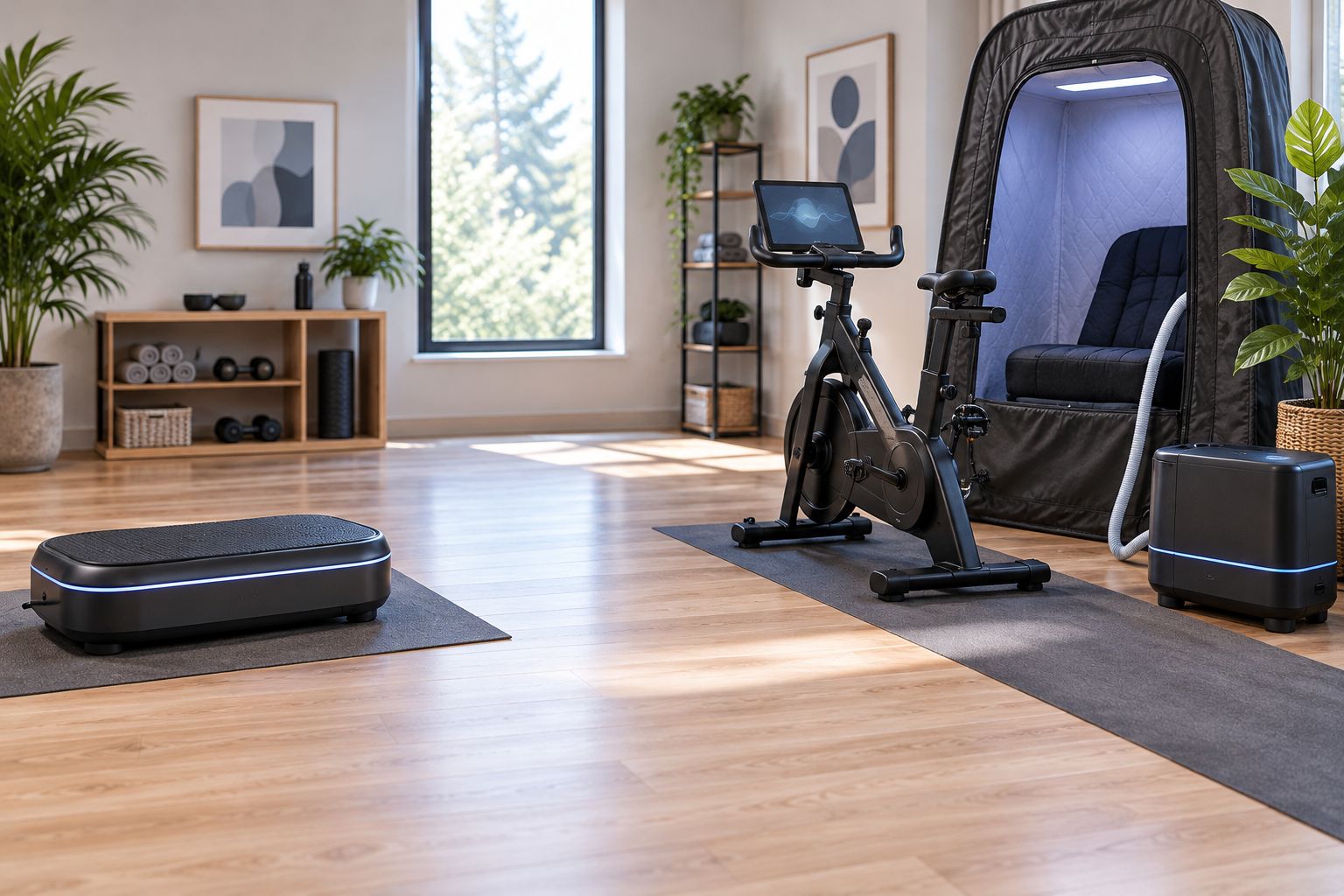
Equipment reference
These products represent the equipment categories above. Use their current instructions and component information to decide whether they belong in your individual setup; the cards do not establish compatibility between products.


Pre-session checks and your 2026 setup record
- Record the equipment identity. Write down the exact models and the manual versions you are following. Keep this record beside the equipment rather than relying on memory.
- Inspect the vibration station. Check the platform, surrounding floor, power connection, and any manufacturer-required support. Do not use damaged equipment.
- Inspect the breathing circuit. Look for damaged tubing, loose connections, visible contamination, and valve problems according to the system instructions. Do not modify or bypass a valve.
- Prepare the oxygen system in the sequence specified by its manufacturer. Confirm its required readiness indicators and any reservoir preparation before putting on the mask or starting exercise.
- Review your stopping rules. Confirm what symptoms require stopping and whom to contact. Do not use a consumer oxygen reading to overrule symptoms or a clinician's instructions.
Expected result: the equipment passes its own readiness checks, and your written plan identifies the settings you will use. An unexplained alarm, missing instruction, or uncertain circuit connection means the session does not start.
Use the actual labels printed on your equipment. Buttons and displays differ by model, so a generic instruction to select a particular mode is not a substitute for the correct manual.
Vibration, transfer, and oxygen-training sequence
Complete the vibration activity
- Start from your individual plan. Use only the posture, intensity, and duration established for you within the equipment instructions. Do not copy a workout intended for a different person or machine.
- Keep the oxygen equipment separate. Leave the breathing circuit at its station rather than wearing a connected mask on the vibrating platform as part of this workflow.
- Stop the platform fully before stepping off. Use the support method specified for your equipment and ability.
- Reassess before moving. If you feel dizzy, faint, unsteady, unusually breathless, or otherwise unwell, do not proceed to oxygen training. Follow your medical stopping plan.
Expected result: the vibration activity is complete, the platform is stopped, and you can transfer without symptoms or balance concerns. Finishing the first activity does not create an obligation to complete the second.
Transfer and begin oxygen training
- Move without the mask attached to you. Reach the next station, establish a stable position, and check the hose route again before connecting yourself to the breathing circuit.
- Fit the approved mask using its instructions. Check the intended valve arrangement and fit without improvising seals or blocking openings.
- Confirm system readiness again. Verify the manufacturer's required operating status immediately before beginning the approved exercise activity.
- Start the planned exercise, using your clinician-approved oxygen settings and exercise instructions. Do not increase flow or intensity to chase a sensation or display reading.
- Finish in the specified sequence. Stop exercise, remove the mask, and shut down or leave equipment operating only as its instructions and your care plan require.
Expected result: you complete the transition without pulling the mask, crossing tubing, or changing oxygen settings outside your plan. The 2026 workflow prioritizes a repeatable handoff, not a target feeling of greater oxygen exposure.
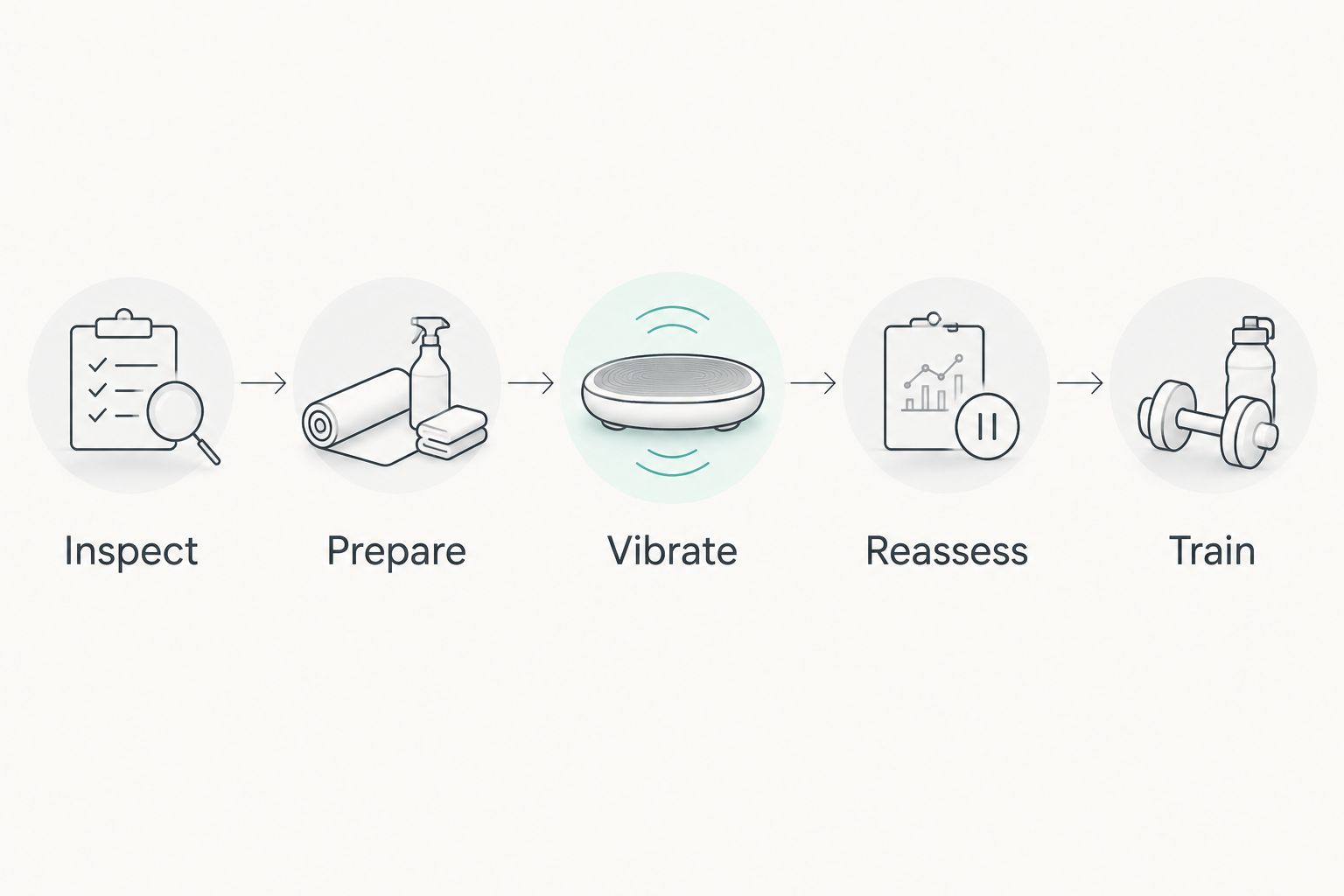
The sequence has 3 checkpoints: before vibration, before oxygen training, and after exercise. At each checkpoint, record whether you continued, stopped, or needed help; do not turn these entries into an unsupported recovery score.
Repeat-day variant: reuse the layout, not yesterday's checks
Best for returning users: preserve a suitable room arrangement while repeating the readiness checks every session. The advantage is less rearranging; the limitation is that familiar equipment still needs inspection.
- Compare the setup with your written equipment record before use.
- Check whether anyone moved the concentrator, changed a mask, disconnected tubing, or altered equipment settings.
- Repeat the inspection and readiness sequence even when nothing appears different.
- Record the day's symptoms and whether you completed each activity.
After replacing a hose, mask, valve, filter, or oxygen source, verify the affected assembly against the relevant instructions before using it. Do not assume a replacement with a similar appearance has the same role.
Keep a 2026 session log with the date, equipment settings, activities completed, symptoms, and maintenance performed. Its purpose is to make changes visible, not to prove that the stack caused a health improvement.
Troubleshooting
The hose pulls on the mask during the transfer
Stop before beginning exercise. Remove the mask, reposition the equipment within the manufacturer's placement requirements, and recheck the route from the intended exercise position. Do not solve tension by adding unverified extensions or joining incompatible tubing.
The mask leaks or feels wrong
Pause the session and review sizing, strap placement, connections, and valves using the mask instructions. Do not overtighten straps to compensate for incorrect sizing, and never tape over an opening or valve to force a seal.
The concentrator alarms or the system is not ready
Do not begin oxygen training. Follow the exact model's alarm instructions and contact the supplier or qualified service provider when the problem remains unresolved; never bypass an alarm or keep adjusting flow until the sound stops.
You feel dizzy after vibration
Stop the routine and move to a safe resting position with assistance if needed. Do not treat oxygen training as the fix. Seek urgent medical help for severe symptoms, chest pain, fainting, or severe breathing difficulty.
The pulse oximeter reading jumps around
Stop movement and follow the oximeter's measurement instructions. Motion and other measurement limitations can affect readings; symptoms and your prescribed action plan take priority. A higher reading does not measure muscle recovery or justify increasing oxygen.
Customize your workflow
Change the organization before changing the dose. Improve storage, recordkeeping, and access to instructions without altering oxygen flow, exercise intensity, or vibration settings on your own.
- Keep the correct manual with each station so another household member cannot confuse the procedures.
- Identify each user's personal components and follow the manufacturer's cleaning and sharing instructions.
- Record maintenance when completed, using the intervals specified for the exact equipment rather than a generic calendar.
- Keep supplements and additional recovery devices outside the initial workflow so you do not add unrelated decisions to setup.
After each session, clean, dry, and store components as directed. Do not spray liquid into a concentrator, electrical housing, or breathing circuit unless the relevant manufacturer explicitly instructs that method.
FAQ
What's the safest way to organize a vibration plate and EWOT recovery stack?
Organize vibration and oxygen training as separate activities with an individual medical plan and a clear transfer route. Follow each device's instructions and reassess before starting the next activity.
Should I use oxygen while standing on the vibration plate?
This workflow keeps oxygen training off the vibration plate. Combining the activities requires specific equipment guidance and individual clinical assessment; do not improvise a shared setup.
How many minutes should each part of the routine last?
Use the duration established for you by your clinician within the equipment instructions. There is no session length in this guide that applies to every person, vibration platform, or oxygen-training system.
Does combining vibration and oxygen training guarantee faster recovery?
No, this workflow provides no guarantee of faster recovery. Equipment readiness, convenience, and a completed session are not evidence that the combination improved recovery.
Can I increase oxygen flow if my pulse oximeter reading stays the same?
Do not change oxygen flow to chase a pulse oximeter reading. Use your prescribed or clinician-approved settings and follow your action plan for unexpected readings or symptoms.
Can I use any mask or hose that fits the connector?
No, connector fit does not establish breathing-circuit compatibility. Verify the complete arrangement, including mask, valves, tubing, oxygen source, and any reservoir requirements, against the system instructions.
What should I put in a 2026 recovery-session log?
Record the date, equipment settings, activities completed, symptoms, and maintenance performed. Keep observations separate from conclusions about whether the routine caused a recovery benefit.
One last thing
The most useful upgrade is an explicit permission to stop between activities. Put your stopping rules beside the transfer route, where you make the next decision—not underneath the equipment manual.
For your 2026 routine, a deliberately skipped oxygen-training session is preferable to continuing through symptoms or uncertain equipment readiness. Completion is not the success measure; following the plan is.
