
Best EWOT systems for biohackers in 2026
Best starting point: XCEL O2 - Wellness Oxygen Training System (EWOT). Best higher-output concentrator component: Drive DeVilbiss 10 LPM Oxygen Concentrator. Best lower-output concentrator component: Drive DeVilbiss 5 LPM Oxygen Concentrator. For the best ewot system for biohackers in 2026, start with the training system—not a concentrator mistaken for a complete setup.
- XCEL O2 is the first EWOT system to evaluate for at-home oxygen training; confirm its included components before ordering.
- Drive DeVilbiss 10 LPM and 5 LPM models are concentrators, not complete exercise-with-oxygen systems.
- Choose oxygen training equipment by documented compatibility, mask fit, maintenance, and room layout—not recovery promises.
- Higher concentrator output does not establish better performance or recovery outcomes.
Why this matters
A concentrator, a mask, and an exercise-with-oxygen system perform different jobs. Buying one does not establish that you have the others, or that the pieces work together.
EWOT is best suited to home oxygen-training buyers who want to evaluate a system alongside its supporting equipment. That makes component selection central to the decision. It does not establish a performance benefit or replace medical advice.
This 2026 guide separates the system from its supporting concentrators. It ranks purchase roles rather than pretending that three product listings represent three complete systems.
What makes the best EWOT system for biohackers?
Use these criteria before comparing equipment:
- System completeness: Establish exactly what the order includes. Identify the oxygen source, delivery components, mask, tubing, and any separately required equipment.
- Documented compatibility: Confirm the concentrator, connections, tubing, and mask against the system's current instructions. Similar-looking fittings are not enough.
- Appropriate output: Match the concentrator to the system requirements. A larger output rating is not a substitute for compatibility.
- Mask fit: Check sizing instructions and the mask's intended use. A mask that shifts during exercise deserves attention before you increase effort.
- Maintenance access: Identify the correct filters, cleaning instructions, and replacement parts before committing to a setup.
- Usable layout: Plan equipment placement and hose routing around the movement you actually perform. Keep the exercise area clear.
For a 2026 purchase, request current documentation rather than relying on an old demonstration video. The decisive question is whether the exact equipment you plan to order forms a supported setup.
EWOT equipment at a glance
The first row is a training system. The remaining rows are oxygen-source components; neither is a stand-alone substitute for that system.
| Item | Best for | Standout feature | Key limitation |
|---|---|---|---|
| XCEL O2 wellness oxygen training system | Starting a home oxygen-training equipment evaluation | Explicitly offered as an exercise-with-oxygen training system | Confirm included components and operating requirements |
| Drive DeVilbiss 10 LPM Oxygen Concentrator | A supported setup requiring the higher listed output | Listed 10 LPM output class | A concentrator alone is not a complete training system |
| Drive DeVilbiss 5 LPM Oxygen Concentrator | A supported setup requiring the lower listed output | Listed 5 LPM output class | Output must match the training system's requirements |
1. XCEL O2: best EWOT system to evaluate for home training
XCEL O2 - Wellness Oxygen Training System (EWOT) is the system-level option in this comparison. Start here if you are assembling an at-home exercise-with-oxygen setup rather than replacing an individual component.
The distinction matters. A named training system gives you a starting point for checking the complete equipment arrangement, but you still need to verify the contents of the exact order.
XCEL O2 pros:
- Explicitly identified as a wellness oxygen training system.
- Relevant to buyers seeking exercise-with-oxygen equipment rather than a general oxygen-source component.
- Listed alongside masks, hoses, concentrators, and other supporting equipment in the same catalog.
XCEL O2 cons:
- The system name alone does not establish which supporting components are included.
- A product listing does not establish an individual performance or recovery benefit.
- Every accessory still needs a compatibility check; a shared retailer does not guarantee a supported connection.
Before ordering, ask for a written equipment list. Have the seller identify the required oxygen source, mask, tubing, connections, and operating instructions for the configuration you are considering.
Best for: Home users beginning a system-level purchase, with medical suitability addressed before use.
Verdict: Hold until the included equipment and setup requirements are confirmed.
2. Drive DeVilbiss 10 LPM: best higher-output component
Drive DeVilbiss 10 LPM Oxygen Concentrator is an oxygen-source component, not a complete EWOT system. Its listed output class distinguishes it from the 5 LPM model below.
Choose between these concentrators using the training system's requirements. Do not translate a higher output rating into a promise of better workouts.
Drive DeVilbiss 10 LPM pros:
- Clearly identified 10 LPM output class.
- A distinct option when the supported equipment arrangement calls for that output.
- A model-specific replacement intake filter is separately listed in the catalog.
Drive DeVilbiss 10 LPM cons:
- Does not replace the training system, mask, or other required delivery components.
- The output rating does not establish compatibility with a particular training setup.
- A higher rating does not demonstrate greater performance or recovery benefits.
Ask which operating settings the system requires and which connections it supports. Confirm the exact concentrator model rather than accepting a general statement that a brand's equipment will work.
Best for: Buyers whose documented system requirements call for the 10 LPM model.
Verdict: Hold until the system documentation confirms this concentrator.
3. Drive DeVilbiss 5 LPM: best lower-output component
Drive DeVilbiss 5 LPM Oxygen Concentrator provides the lower listed output class in this comparison. It belongs on your shortlist only when that model meets the training system's documented requirements.
A 5 LPM label describes equipment output, not a recommended exercise intensity. It also does not establish that this concentrator is sufficient for every oxygen-training arrangement.
Drive DeVilbiss 5 LPM pros:
- Clearly identified 5 LPM output class.
- An alternative to the higher-output model when supported by system instructions.
- A model-specific replacement intake filter is separately listed in the catalog.
Drive DeVilbiss 5 LPM cons:
- Not a complete exercise-with-oxygen system.
- Unsuitable as a default choice without checking the required output.
- Does not establish the oxygen concentration ultimately inhaled during exercise.
Do not select the lower-output model simply because you consider yourself a beginner. Equipment requirements and exercise experience answer different questions.
Best for: Buyers with a supported setup that specifically accepts this 5 LPM concentrator.
Verdict: Hold until the required output and exact model are confirmed.
How the ranking works
This 2026 ranking follows purchase order: identify the training system, then select a supported oxygen source. System completeness comes first; compatibility, output, fit, maintenance, and layout determine whether the arrangement makes sense for you.
The ranking does not treat product descriptions as clinical evidence. Nor does it assign a winner for recovery, endurance, or longevity without supporting outcome data.
The products below represent the system and concentrator roles discussed above. Their appearance together is not confirmation that they form a supported package.


Build the setup around your room and routine
Before adding accessories, map the physical arrangement. Your exercise equipment, oxygen equipment, and hose route need to coexist without putting tubing across your normal path.
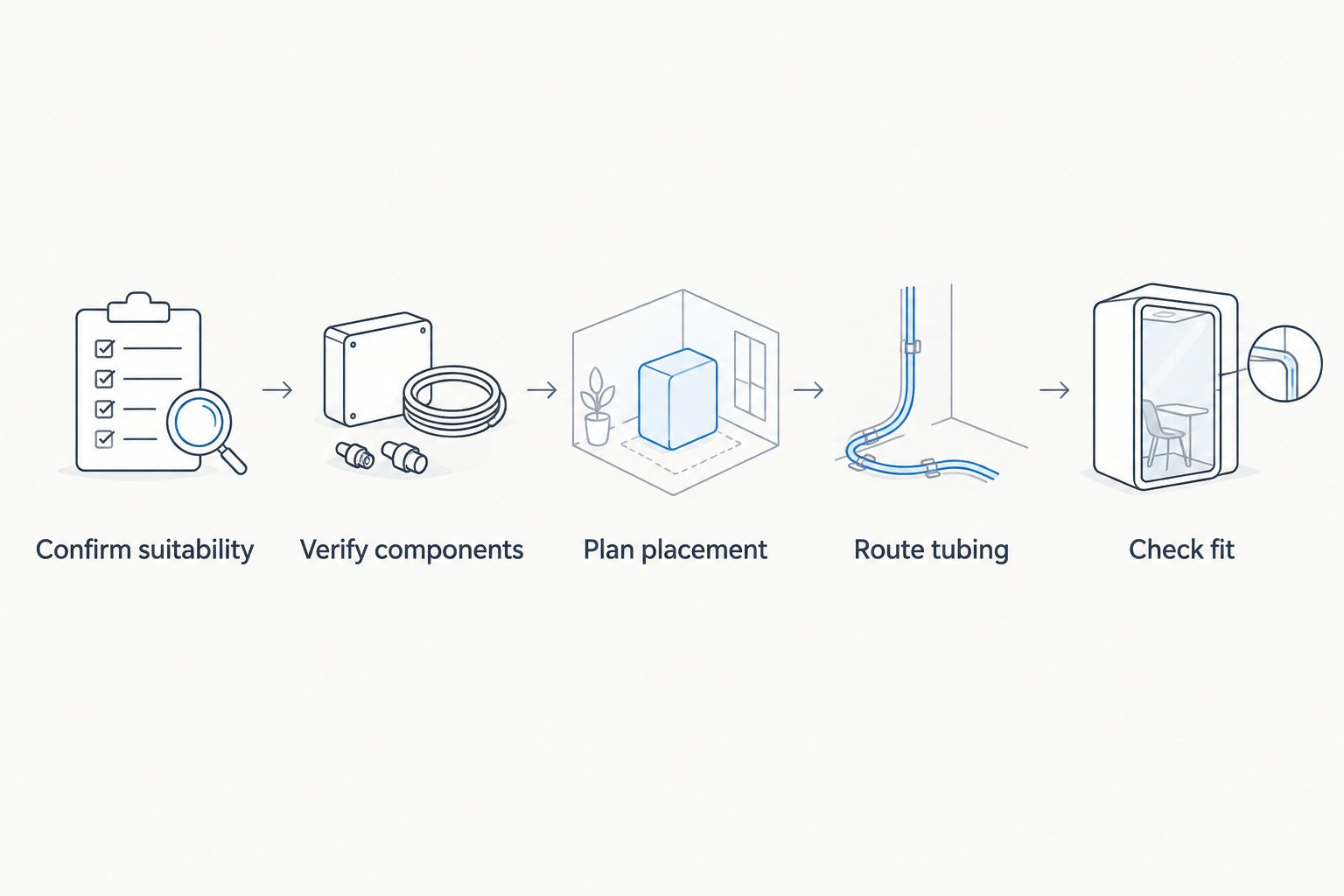
Use this sequence:
- Confirm suitability: Discuss supplemental oxygen during exercise with a qualified clinician, especially if you have a medical condition or use prescribed oxygen.
- Verify components: Obtain the exact supported equipment list and operating instructions.
- Plan placement: Follow equipment clearance instructions and leave access for inspection and maintenance.
- Route tubing: Keep the hose away from moving exercise parts and walking routes.
- Check fit: Follow mask sizing and fitting instructions before exercising.
The catalog includes 6 ft and 9 ft hose options, plus a 10 ft tube. Those lengths help you plan a route, but length alone does not establish the correct diameter, fitting, material, or permitted configuration.
Use only the tubing arrangement the system supports. An extender solves a reach problem only when the resulting connection and hose run remain appropriate for the equipment.
Decide between a home setup and a supervised setting
Your purchase decision includes more than hardware. Decide who will help establish medical suitability, demonstrate the equipment, and resolve questions about fitting or operation.
If you compare a home system with EWOT studios in Orange County, evaluate the same practical issues: staff qualifications, screening procedures, cleaning practices, and the exact equipment used. A studio location or an equipment brand is not evidence of a health outcome.
Best for home equipment: Buyers prepared to follow operating instructions, maintain the equipment, and address suitability with a clinician. The trade-off is responsibility: you manage the room, cleaning, inspections, and day-to-day setup.
Best for an attended setting: Buyers who want an equipment demonstration before committing to a home arrangement. The limitation is that being attended does not itself establish medical supervision; ask who provides oversight and what that oversight includes.
Keep the comparison practical. Ask what happens if the mask does not fit, you feel unwell, or the equipment alarms. Clear answers matter more than an ambitious wellness claim.
Separate maintenance from accessories
Maintenance belongs in the purchase decision, not on a later shopping list. Identify the applicable instructions for each component and keep them accessible near the equipment.
For concentrators, match replacement filters to the exact model. The catalog separately names filters for the DeVilbiss 525DS and 1025DS; do not infer interchangeability from the DeVilbiss name.
For masks, distinguish sizing, cleaning, and replacement requirements. The Clear XCEL O2 mask description calls for face measurement, while the Blue XCEL O2 description identifies a non-rebreather valve and medical-grade silicone. Those details do not make the two masks interchangeable for every user or cleaning process.
Use this maintenance checklist:
- Record the exact equipment model and relevant part identifiers.
- Follow each manufacturer's cleaning method, not a general household routine.
- Confirm that a disinfectant is approved for the particular surface and material.
- Inspect tubing and connections as directed by the equipment instructions.
- Keep oxygen equipment away from smoking, flames, and ignition sources.
Oxygen supports combustion. Treat fire precautions as a basic operating requirement, not an optional upgrade.
Measure your routine without overstating the results
A useful 2026 equipment log records what you actually did: the exercise, duration, perceived effort, equipment settings, and any symptoms. Keep the routine consistent enough that the record remains interpretable.
A finger pulse oximeter estimates blood oxygen saturation. It does not measure tissue oxygen delivery, establish recovery, or prove that a training intervention worked; motion and other factors can affect readings.
Do not chase a saturation number as a performance target. Follow clinical guidance where applicable, and never change prescribed oxygen settings to copy a wellness routine.
Keep safety separate from experimentation. Stop exercise if you develop concerning symptoms, and seek medical assessment rather than trying to correct them by changing oxygen equipment settings.
Which EWOT equipment should you choose in 2026?
Start by evaluating XCEL O2 if you need a training system. Confirm its exact contents and required supporting equipment before selecting a concentrator or accessory.
Choose Drive DeVilbiss 10 LPM only when the supported setup calls for that model. Choose Drive DeVilbiss 5 LPM only when it meets the documented requirements; neither rating establishes a better personal outcome.
If those requirements remain unclear, wait. A written, supported equipment arrangement is a stronger buying signal than a larger number on a concentrator.
FAQ
What's the best EWOT system for biohackers in 2026?
XCEL O2 is the system-level option to evaluate first in this comparison. Confirm the included equipment, supported concentrator, and medical suitability before ordering; the concentrators listed alongside it are components, not complete systems.
Is a 10 LPM concentrator better than a 5 LPM concentrator for oxygen training?
A 10 LPM concentrator has the higher listed output class, but that does not make it the better choice for every setup. Select the exact model supported by the training system's requirements.
Can I use an oxygen concentrator alone as an EWOT system?
An oxygen concentrator alone is not a complete exercise-with-oxygen system. You need the supported delivery arrangement and operating instructions for the training setup you intend to use.
Does XCEL O2 include everything I need?
Confirm the exact order contents before purchasing XCEL O2. Ask for a written list identifying included components and any separately required concentrator, mask, tubing, or connections.
How do I choose an oxygen-training mask?
Choose a mask that meets the system's compatibility requirements and fits according to its sizing instructions. Do not assume that every oxygen mask supports the same training arrangement.
Does a higher pulse oximeter reading prove better recovery?
A higher pulse oximeter reading does not prove better recovery. A pulse oximeter estimates blood oxygen saturation, not tissue oxygen delivery or the effectiveness of an exercise program.
Should I ask a clinician before exercising with supplemental oxygen?
Discuss supplemental oxygen during exercise with a qualified clinician before starting. This is especially important if you have a medical condition, concerning symptoms, or an existing oxygen prescription.
One last thing
Before placing an order, write one sentence that names every required component in your proposed setup. Then ask the seller to confirm that exact arrangement against the current instructions.
If the answer substitutes a general wellness promise for a component-by-component confirmation, pause the purchase. Buy a supported setup, not a collection of plausible parts.
