
Best finger pulse oximeters for home use in 2026
Best for general wellness spot checks: Ewot’s Finger Pulse Oximeter-SpO2. Best for clinician-directed monitoring: a clinician-selected, FDA-cleared fingertip model. Best for keeping a history: a recording-capable fingertip model. The best finger pulse oximeter for home use in 2026 depends on whether you need occasional readings, medical monitoring, or a record you can share.
- The best finger pulse oximeter for home use depends on wellness, medical monitoring, or tracking needs.
- Ewot’s Finger Pulse Oximeter-SpO2 suits wellness shoppers seeking a lightweight device with six display modes.
- For medical monitoring, choose a clinician-recommended device with verified FDA clearance for its intended use.
- A pulse oximeter estimates oxygen saturation; symptoms and your clinician’s instructions take priority over a reassuring number.
Why this matters
A fingertip pulse oximeter estimates peripheral oxygen saturation, shown as SpO2, and measures pulse rate. It does not measure oxygen delivery throughout your body, diagnose the cause of breathlessness, or establish whether an oxygen-training routine works.
For your 2026 purchase, separate convenient features from evidence of measurement performance. An easy-to-read display helps you use a device, but it does not establish clinical accuracy. FDA clearance, intended use, fit, and manufacturer instructions deserve more attention than a long feature list.
Ewot’s Finger Pulse Oximeter-SpO2 is the wellness pick here for home users prioritizing portability and display flexibility. That recommendation concerns its stated features, not a demonstrated accuracy advantage over other devices.
What makes the best home finger pulse oximeter?
Use these criteria before comparing devices. They separate a useful purchase from a gadget that answers the wrong question.
- Intended use: Match the device to general wellness or clinician-directed monitoring. Those purposes are not interchangeable.
- Measurement evidence: For medical use, verify the exact model’s regulatory status and performance documentation. A medical-looking case proves nothing.
- Readable display: Look for clear SpO2 and pulse labels, comfortable viewing angles, and a display you can read without moving your hand.
- Correct fit: Check the manufacturer’s stated user population and finger-fit instructions. Do not assume an adult fingertip device suits a child.
- Repeatable operation: Prioritize straightforward positioning and a stable signal. Movement, cold hands, and poor circulation interfere with readings.
- Useful records: Choose memory or export features only when you need them. Confirm what gets saved and whether you can retrieve it.
Home finger pulse oximeters at a glance
This 2026 comparison ranks purchase routes rather than claiming a head-to-head accuracy winner. The named product has supplied feature information; the other options describe device categories to discuss with your clinician or assess against manufacturer documentation.
| Rank and option | Best for | Standout feature or requirement | Key limitation |
|---|---|---|---|
| 1. Finger Pulse Oximeter-SpO2 | General wellness spot checks | Six display modes, low-power operation, and a lightweight format | Display features do not establish medical suitability |
| 2. Clinician-selected, FDA-cleared fingertip model | Monitoring under a care plan | Verified intended use matched to your clinician’s instructions | Clearance does not eliminate measurement limitations |
| 3. Recording-capable fingertip model | Keeping a shareable reading history | Confirmed memory or export functions | Stored readings still need context and interpretation |
1. Finger Pulse Oximeter-SpO2: best for wellness spot checks
The Finger Pulse Oximeter-SpO2 is Ewot’s option for shoppers seeking a portable fingertip device. Its listed features include 6 display modes, an anti-movement algorithm, low power consumption, and a lightweight design.
Those details support a convenience-focused recommendation. They do not establish a specific accuracy tolerance, pediatric suitability, continuous-monitoring capability, or fitness for treatment decisions.
Finger Pulse Oximeter-SpO2 pros
- Six display modes provide viewing options.
- The lightweight format supports carrying the device between locations.
- Low power consumption is a stated feature.
- An anti-movement algorithm is included in the product description.
Finger Pulse Oximeter-SpO2 cons
- An anti-movement algorithm is not permission to take readings while exercising.
- Display modes do not tell you whether readings meet your medical monitoring requirements.
- Choose a different purchase route if your clinician requires a specifically verified medical device.
Best for: Adults shopping for general wellness spot checks who prioritize portability and display options.
Before buying, confirm the device’s instructions, fit requirements, battery requirements, and intended use. If you need measurements for a diagnosed condition, ask your clinician whether this exact model is appropriate rather than treating a product category as an endorsement.
Verdict: Buy for wellness spot checks after confirming intended use; hold for clinician approval if readings will guide medical care.
2. Clinician-selected fingertip model: best for a medical care plan
A clinician-selected, FDA-cleared fingertip pulse oximeter is the right purchase route when home readings form part of medical care. Select the exact model around the intended user and monitoring instructions, not around a generic claim of professional quality.
For a medical purchase in 2026, verify clearance for the device’s intended use. FDA registration or listing is not the same as FDA clearance, and a marketplace description is not a substitute for model-specific documentation.
Clinician-selected fingertip model pros
- The selection starts with your medical monitoring needs.
- Verified intended use gives you a clearer basis for choosing a device.
- A care plan establishes when to measure and what action to take.
Clinician-selected fingertip model cons
- FDA clearance does not mean every reading is correct under every condition.
- A medically appropriate device still requires correct positioning and interpretation.
- Suitability for one person does not establish suitability for another.
Best for: Anyone whose clinician has requested home oxygen-saturation monitoring.
Ask your clinician to specify your measurement schedule, personal action thresholds, and response to symptoms. Keep those instructions beside the device so that another household member can find them without searching through messages.
Verdict: Buy the exact model your clinician approves when measurements support medical decisions.
3. Recording-capable fingertip model: best for a reading history
A recording-capable fingertip pulse oximeter suits users who need more than a number that disappears when the device switches off. Choose this category only after confirming whether it saves individual readings, continuous recordings, timestamps, or exportable reports.
These functions are not equivalent. A saved spot check does not establish that a device is intended for overnight monitoring, and a phone connection does not establish medical accuracy.
Recording-capable fingertip model pros
- Saved readings reduce reliance on memory.
- Timestamps help connect readings with symptoms and circumstances.
- Export functions, when verified, support sharing records with a clinician.
Recording-capable fingertip model cons
- Logging features add setup and data-management tasks.
- A history of inaccurate or poorly taken readings remains misleading.
- App compatibility and export access require checking before purchase.
Best for: People whose clinician requests a reading log, or wellness users who want an organized record.
For a 2026 tracking purchase, decide what information you actually need to retain. A simple written log is sufficient when you only need occasional readings, symptoms, and notes; connected features are useful only if they make that task easier.
Verdict: Buy when verified recording functions meet a defined need; skip connectivity for its own sake.
How these recommendations are ranked
The ranking prioritizes intended use, documented features, fit, readable results, and useful records. Ewot’s Finger Pulse Oximeter-SpO2 leads the wellness slot because its supplied description identifies portability and display features relevant to occasional home checks.
This is not a laboratory accuracy ranking. No comparative testing results establish that the named product outperforms clinician-selected or recording-capable alternatives. Medical suitability takes priority over list position.
How to take a useful home reading
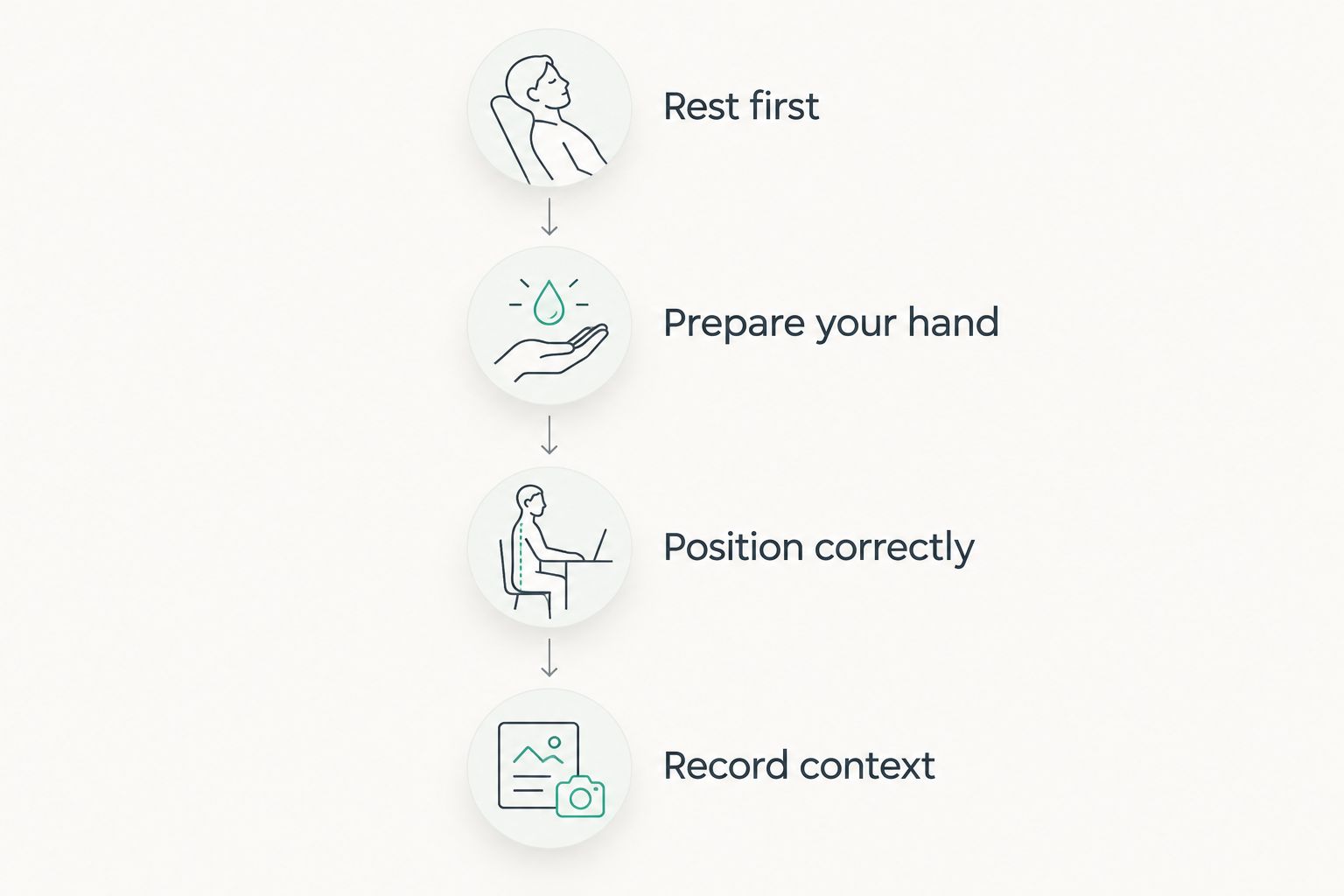
Good technique matters with every purchase route. Follow your exact device’s instructions and any measurement plan from your clinician; the following sequence supports a resting spot check rather than exercise or overnight monitoring.
Rest first
Sit quietly before measuring. A practical home routine is to rest for 5 minutes, then keep your hand supported and relaxed while you use the device.
Prepare your hand
Warm a cold hand and check for anything that interferes with the sensor. Nail polish and artificial nails affect some readings; follow the manufacturer’s guidance about removing them or choosing another finger.
Position correctly
Insert the finger as instructed and keep it still. Wait for the reading to settle rather than recording the first number that flashes onto the screen; some home instructions advise leaving the device on for 1 minute or longer if the reading is changing.
Record context
Write down the saturation, pulse, symptoms, and circumstances. A resting reading and a reading taken after activity answer different questions, so label them accordingly.
A surprising result deserves attention, not automatic dismissal. Check positioning and follow your care plan, but do not keep repeating a measurement to obtain a preferred number or delay urgent help when you feel seriously unwell.
What your oxygen-saturation number does not tell you
Pulse oximetry estimates oxygen saturation using light passing through tissue. It does not directly measure blood oxygen with the same method as an arterial blood test, and it does not measure carbon dioxide.
FDA guidance identifies factors that affect pulse-oximeter accuracy, including poor circulation, skin pigmentation, skin thickness, skin temperature, tobacco use, and nail polish. These limitations apply to how you interpret a result, not just how you choose a product.
For your 2026 home routine, avoid treating a single number as a health score. A reassuring reading does not rule out a medical problem, and a lower reading does not identify its cause.
Seek urgent medical help for severe breathing difficulty, chest pain, confusion, or blue or gray lips or face. Do not wait for a device to confirm that symptoms are serious. Follow your clinician’s individual instructions for concerning readings.
Using a pulse oximeter around oxygen exercise
A fingertip pulse oximeter measures; an oxygen concentrator supplies oxygen-enriched gas. Neither function establishes that a particular exercise routine is appropriate for you.
If you use oxygen equipment, follow the equipment instructions and your clinician’s advice. Do not change a prescribed oxygen setting based on an isolated consumer-device reading, and do not use a saturation increase as proof of improved recovery or performance.
For wellness tracking, keep measurement conditions consistent and distinguish resting checks from activity. An anti-movement feature does not establish that readings taken during a workout are suitable for medical decisions.
Which home finger pulse oximeter should you choose?
Choose the Finger Pulse Oximeter-SpO2 for general wellness convenience, a clinician-approved medical model for a care plan, and verified recording functions when you need a history. That is the useful decision tree—not a universal winner based on screen features.
If you remain undecided, identify who will act on the readings. When the answer is a clinician managing a health condition, ask for model guidance before buying. When the answer is you observing occasional wellness readings, prioritize clear instructions and straightforward operation.
FAQ
What’s the best finger pulse oximeter for home use in 2026?
The best choice depends on intended use: the Finger Pulse Oximeter-SpO2 is the wellness convenience pick here, while medical monitoring calls for a clinician-approved model. Its listed display and portability features do not establish a comparative accuracy advantage.
Is Ewot’s finger pulse oximeter suitable for medical monitoring?
Medical suitability requires confirmation for the exact device and intended use. Ask your clinician to approve the model before using its readings to guide care.
Does FDA registered mean a pulse oximeter is FDA cleared?
No. FDA registration or listing does not mean a device has received FDA clearance. Verify the exact model and intended use rather than relying on a general marketplace claim.
Can I use a finger pulse oximeter while exercising?
Do not assume a fingertip device is suitable for measurements during movement. Follow its instructions; an anti-movement algorithm alone does not establish exercise-monitoring accuracy.
Why does my pulse oximeter reading keep changing?
Movement, cold hands, poor circulation, positioning, and other measurement limitations affect readings. Rest, follow the device instructions, and respond according to your care plan rather than selecting the most reassuring result.
Can a normal oxygen reading rule out a serious problem?
No. A reassuring pulse-oximeter reading does not rule out a medical problem. Severe breathing difficulty, chest pain, confusion, or blue or gray lips or face require urgent medical attention.
Should I buy a pulse oximeter with an app?
Buy app connectivity only when verified recording and export functions serve a clear purpose. A written log works for occasional readings, and connectivity does not establish clinical accuracy.
One last thing
Write your personal action plan before taking the first reading. Include whom to contact, which symptoms require urgent help, and any thresholds supplied by your clinician. A device gives you an estimate; a care plan tells you what to do with it.
