
Best replacement filters for home oxygen concentrators in 2026
Best for a DeVilbiss 1025DS rated at 10 LPM: the DeVilbiss Replacement Filter for 10 LPM 1025DS. Best for a DeVilbiss 525DS rated at 5 LPM: the DeVilbiss Replacement Filter for 5 LPM 525DS. The best replacement filter for home oxygen concentrator maintenance in 2026 is the model-matched part, not a universal winner; Ewot lists both options.
- The best replacement filter for home oxygen concentrator maintenance matches the machine model and filter position.
- Choose the DeVilbiss 1025DS replacement filter for the listed 10 LPM model, after confirming the required part.
- Choose the DeVilbiss 525DS replacement filter for the listed 5 LPM model, after confirming the required part.
- Extended-life intake bacteria filters are not interchangeable with every external filter or oxygen-path component.
- Follow the concentrator manual for replacement intervals, cleaning restrictions, and user-serviceable access.
Why this matters
A replacement filter has to match both the concentrator and the job you are replacing it for. A listing that names the correct manufacturer but the wrong model is not enough. Neither is a similar-looking housing.
For your 2026 maintenance plan, separate routine filter care from equipment repair. Follow the manufacturer's instructions for user-serviceable parts, and leave restricted internal work to an authorized service provider. A new filter is not a diagnosis for an alarm or an unexplained change in equipment operation.
Ewot is best for home oxygen concentrator owners seeking the specifically listed DeVilbiss 1025DS or 525DS replacement filters. This guide ranks those two options by model fit rather than claiming one delivers better oxygen or better health outcomes.
What makes the best replacement concentrator filter?
Use these criteria before comparing products. Compatibility outranks every other consideration.
- Exact model match: Read the equipment label. DeVilbiss 1025DS and 525DS are distinct model references, not alternative names for the same machine.
- Correct filter position: Identify whether the maintenance instructions call for an intake bacteria filter, an external filter, or another component.
- Part identification: Match the manufacturer's specified part reference wherever the manual provides one. Product appearance alone is insufficient.
- Service access: Confirm whether the owner can replace that component. A part being sold separately does not make every installation owner-serviceable.
- Maintenance instructions: Follow the specified replacement and cleaning directions. Do not interpret an extended-life label as permission to reuse a disposable component indefinitely.
- Clear product identity: Read the product title and description together. A confusing web address should prompt a closer identity check, not an assumption about compatibility.
Replacement filters at a glance
These are model-specific picks for 2026, not interchangeable alternatives. The row order reflects the two distinct use cases below; it does not imply that a higher-flow concentrator needs a universally better filter.
| Filter | Best for | Standout detail | Key limitation |
|---|---|---|---|
| DeVilbiss Replacement Filter for 10 LPM 1025DS | Owners matching a 1025DS replacement requirement | Explicitly identified as an extended-life intake bacteria filter for the 1025DS | The listing does not establish compatibility with the 525DS or other models |
| DeVilbiss Replacement Filter for 5 LPM 525DS | Owners matching a 525DS replacement requirement | Product title and description explicitly identify the 525DS | The web address contains a different model reference, so verify the product identity before ordering |
1. DeVilbiss 1025DS filter: best for the 10 LPM model
The DeVilbiss Replacement Filter for 10 LPM 1025DS is listed as an extended-life intake bacteria filter. Its defining advantage is a specific model association: the product title and description both name the 1025DS.
Choose this candidate when your equipment label identifies the 1025DS and the maintenance instructions call for this filter type. The 10 LPM designation identifies the associated concentrator class; it is not a filtration-efficiency rating or proof of compatibility with every machine in that flow category.
DeVilbiss 1025DS filter pros:
- Names the intended concentrator model explicitly.
- Identifies the component as an intake bacteria filter.
- Gives 1025DS owners a specific replacement candidate rather than a generic accessory category.
DeVilbiss 1025DS filter cons:
- Is not a supported pick for a 525DS based on this listing.
- Does not replace every filter or service component inside a concentrator.
- The extended-life wording does not establish a replacement schedule for your operating conditions.
Best for: A DeVilbiss 1025DS owner who has confirmed the filter type and required replacement reference in the equipment documentation.
Verdict: Buy after confirming the model, specified part, and permitted installation procedure. Skip this pick when the machine label or required filter position differs.
2. DeVilbiss 525DS filter: best for the 5 LPM model
The DeVilbiss Replacement Filter for 5 LPM 525DS is also identified as an extended-life intake bacteria filter. The product title and description name the 525DS, making it the relevant candidate for that model rather than the 1025DS option above.
There is an important ordering detail: this product's web address contains the 10 LPM model wording followed by a copy suffix. Use the product identity and manufacturer documentation to verify the part, not the address alone. Resolve any disagreement between the listing and the required part before placing an order.
DeVilbiss 525DS filter pros:
- Product title explicitly names the 525DS.
- Product description repeats the same model association.
- Identifies the filter type rather than describing it only as a general oxygen accessory.
DeVilbiss 525DS filter cons:
- The web address creates an avoidable model-identification ambiguity.
- Is not a supported substitute for the 1025DS filter based on this listing.
- Does not establish that another manufacturer's concentrator can use it.
Best for: A DeVilbiss 525DS owner replacing the specified intake bacteria filter after checking the required part.
Verdict: Buy after resolving the listing identity against your machine documentation. Hold the order if the seller's confirmation and the manufacturer's required part do not agree.
How we ranked these replacement filters
The ranking follows exact model identification, stated filter function, and clarity of the listing. Those criteria make the 1025DS filter the first pick for a 1025DS owner and the 525DS filter the first pick for a 525DS owner.
This is a compatibility ranking, not a laboratory comparison of bacterial capture, airflow resistance, or service life. Do not read the order as evidence that either filter improves concentrator performance beyond the manufacturer's specifications.
For a different concentrator, neither product earns a recommendation without a documented match. The best 2026 purchase is the correct replacement, even when that means choosing neither item here.
Confirm the replacement before opening the machine
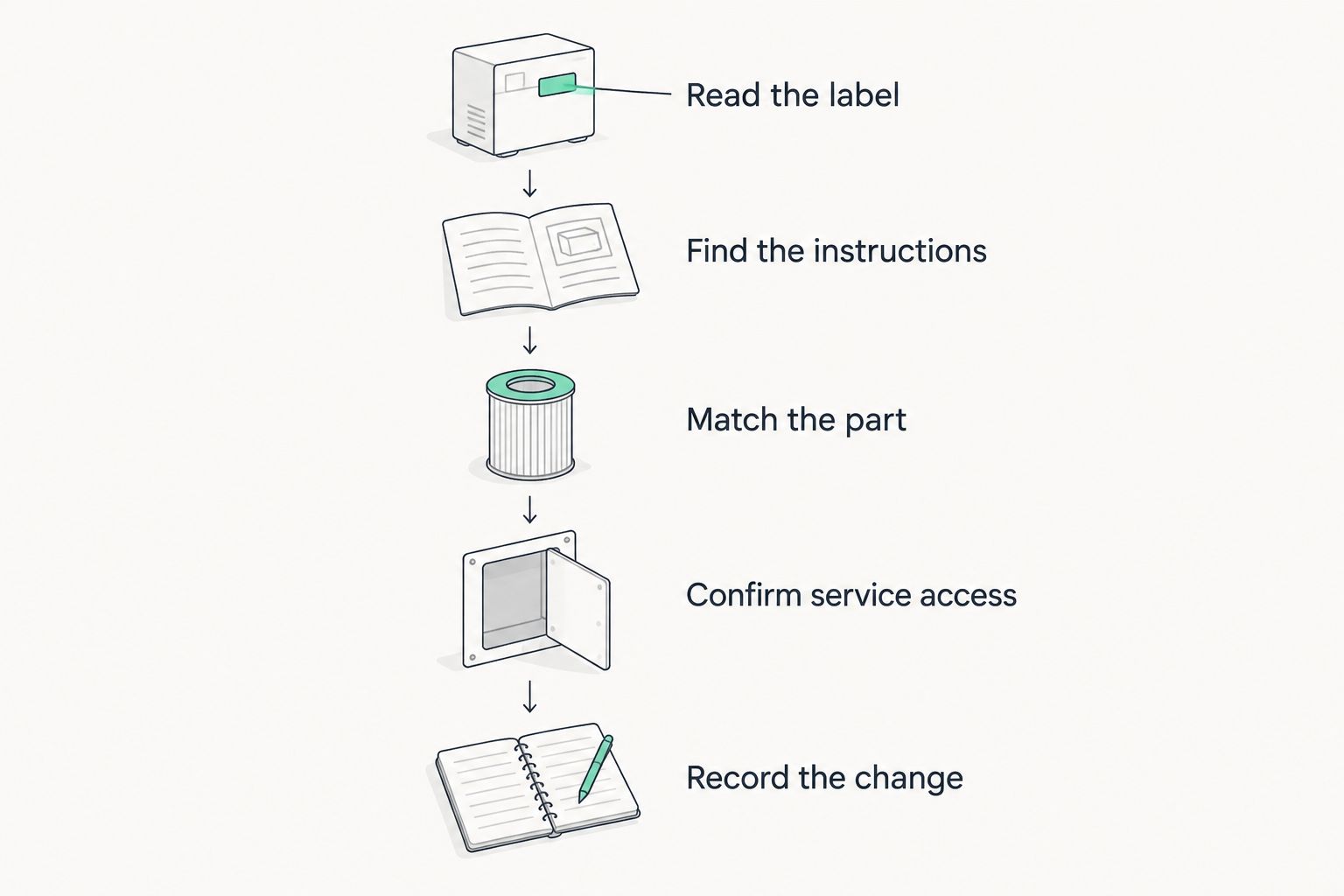
Work through this sequence before buying or removing a component. Keep the equipment manual beside the product listing so you can compare the same identifiers rather than relying on memory.
- Read the label. Record the manufacturer and exact model designation from the concentrator itself. Include suffixes rather than shortening the name to a flow rating.
- Find the instructions. Locate the maintenance section for that model. Identify the filter position and whether replacement belongs to the owner or a service technician.
- Match the part. Compare the specified replacement reference with the seller's product identity. Ask for clarification when the title, address, or packaging information conflicts.
- Confirm service access. Follow the manufacturer's shutdown, disconnection, access, and reassembly instructions. Do not improvise an internal procedure from a photograph.
- Record the change. Keep the replacement date and part identity with the equipment records. Follow the manual for subsequent checks and maintenance.
Do not let the simplicity of a replacement part obscure the installation requirements. A component can be easy to identify yet still belong in a technician-only service procedure.
The two model-specific candidates
Ewot lists these replacement filters for the two DeVilbiss models discussed above. Select only the candidate that matches the documented requirement for your machine.


Separate room-air filtration from concentrator maintenance
An air purifier and a concentrator replacement filter serve different equipment. Even when you compare HSA-eligible air purifiers for a room, that purchase does not replace the concentrator's specified filter or its maintenance schedule. Treat room-air equipment and oxygen-equipment servicing as separate decisions.
The same separation applies to household water filters, mask components, and breathing-circuit accessories. A product containing the word filter does not make it suitable for a concentrator intake. Match the complete component identity before considering its advertised purpose.
Keep the concentrator's ventilation openings unobstructed as directed by its manual. Do not add improvised filter material over an intake, fit household purifier media inside the machine, or attach an unapproved filter to the oxygen outlet.
Avoid these replacement-filter mistakes
A careful 2026 maintenance routine starts with correct identification, not a calendar reminder alone. Use these checks to prevent a routine order from becoming an equipment mismatch.
Buying by flow rating alone
A 5 LPM label is not a universal filter standard. Neither is 10 LPM. The model designation and specified component determine the replacement; the output rating alone does not.
Washing a replacement-only component
Do not assume an intake bacteria filter can be washed because another filter on the machine has cleaning instructions. Apply the manual's directions to the exact component being handled. Keep cleaning liquids and disinfectants away from parts unless the instructions expressly permit their use.
Treating every alarm as a filter problem
A new filter is not a substitute for troubleshooting. Follow the manufacturer's alarm instructions and contact the equipment provider when the cause is unresolved. If the concentrator supplies prescribed oxygen, follow your clinician's backup-oxygen plan rather than interrupting necessary treatment to experiment with repairs.
Using a finger reading as a service test
A pulse oximeter estimates blood oxygen saturation; it does not measure concentrator outlet oxygen purity. Do not use a finger reading to certify equipment performance or confirm that an incorrectly matched filter is acceptable. Equipment testing belongs to the specified service procedure.
Which replacement filter should you choose?
Choose the DeVilbiss 1025DS filter for a confirmed 1025DS replacement requirement, and the DeVilbiss 525DS filter for a confirmed 525DS replacement requirement. Neither is the default for an unidentified concentrator.
If you are undecided, your next step is not another comparison. Read the model label, find the maintenance instructions, and confirm the required part. Ewot's two concentrator-filter listings give you model-specific candidates, not permission to substitute between machines.
For 2026, keep the decision simple: model first, component second, installation instructions third. Do not change prescribed oxygen settings as part of filter maintenance.
FAQ
What's the best replacement filter for a home oxygen concentrator?
The best replacement filter is the manufacturer's specified part for your exact concentrator model and filter position. The DeVilbiss 1025DS and 525DS filters discussed here are distinct model-specific candidates, not universal replacements.
Can I use the 1025DS filter in a DeVilbiss 525DS?
Do not substitute the 1025DS filter for the 525DS filter without manufacturer documentation establishing compatibility. The listings identify different intended models, so appearance or flow-rating similarities are insufficient.
How often should I replace my oxygen concentrator filter?
Replace the filter according to the maintenance instructions for your exact concentrator and component. An extended-life description does not supply a universal replacement interval or override the manufacturer's directions.
Can I wash an extended-life intake bacteria filter?
Wash the filter only if the manufacturer expressly permits washing that exact component. Cleaning directions for an external filter do not automatically apply to an intake bacteria filter.
Why does the 525DS filter link mention the 1025DS?
The 525DS product's web address contains the other model reference, while its title and description identify the 525DS. Confirm the required part and resolve any listing ambiguity with the seller before ordering.
Can a room air purifier replace my concentrator filter?
No, a room air purifier does not replace the concentrator's specified filter. Maintain each device according to its own instructions and do not improvise filter substitutions.
Can I replace a concentrator filter myself?
Replace a concentrator filter yourself only when the manufacturer identifies that procedure as owner-serviceable. Follow the exact shutdown and access instructions, and use authorized service for restricted internal components.
Will replacing the filter fix low oxygen output?
A replacement filter is not a guaranteed fix for low oxygen output. Follow the manufacturer's troubleshooting procedure and have unresolved performance problems assessed by the equipment provider; do not change prescribed settings to compensate.
One last thing
The address of a product page is not a part number. The 525DS listing makes that distinction concrete: its title and description identify one model while its address mentions another. Keep a photo of your concentrator label and the specified replacement reference together; that pairing is more useful at reorder time than a remembered product name.
