
Can you do EWOT without an oxygen concentrator?
Yes, you can do EWOT without an oxygen concentrator if another suitable source supplies the supplemental oxygen, or if a compatible reservoir has already been filled. You cannot replace that oxygen source with an empty bag, a disconnected mask, or a breathing-resistance device. A cylinder-based alternative needs professional equipment matching and oxygen-safety guidance; it is not a do-it-yourself substitution.
- EWOT without oxygen concentrator equipment still requires supplemental oxygen from a suitable source.
- A prefilled reservoir removes the need to run a concentrator during exercise, not the need to supply oxygen.
- Compressed oxygen requires a compatible regulator and delivery system; a cylinder alone is not a complete setup.
- A mask or breathing-resistance device cannot turn room air into oxygen-enriched gas.
Why this matters
Not owning a concentrator and not using supplemental oxygen are different decisions. Confusing them leads you to compare equipment that performs entirely different jobs: producing oxygen-enriched gas, storing it, and delivering it during exercise.
If you are choosing a home setup in 2026, start with the oxygen source rather than the mask. The best oxygen concentrators for EWOT training guide covers that equipment category; the decision here is whether your intended setup needs a concentrator at all.
This is an equipment explanation, not a recommendation to start oxygen therapy. Ask your clinician whether supplemental oxygen during exercise is appropriate, especially if you have a heart or lung condition or already use prescribed oxygen.
Can you do EWOT without an oxygen concentrator?
Yes, but only if the complete system still delivers supplemental oxygen appropriately. A concentrator is one way to provide that oxygen; it is not the only possible source.
A concentrator separates gases from surrounding air to produce oxygen-enriched output. A compressed-oxygen cylinder stores oxygen supplied elsewhere. A reservoir stores gas temporarily, so its contents depend on what filled it.
| Configuration | Best for | Main advantage | Main limitation |
|---|---|---|---|
| Concentrator with a compatible reservoir | Repeated home sessions with a matched system | Produces oxygen-enriched gas on site | Requires power, maintenance, and preparation |
| Professionally matched oxygen-cylinder system | A setup specifically designed for cylinder supply | Does not require a concentrator to produce oxygen on site | Requires cylinder replenishment, secure storage, and suitable regulation |
| Previously filled compatible reservoir | Separating preparation from exercise | The concentrator does not necessarily need to run during exercise | Stores a finite supply and still needs an approved filling source |
| Mask or resistance device using room air | Ordinary exercise or a separate breathing-training purpose | Does not require an oxygen supply | Does not provide oxygen-enriched breathing gas |
A reservoir changes when oxygen is supplied; it does not create oxygen. That distinction answers most versions of this question, including whether you can unplug a concentrator after filling a bag.
Follow the system manufacturer's instructions on preparation and operation. Do not assume a reservoir is approved for disconnected use simply because it holds gas.
A prefilled reservoir: no concentrator running during exercise
A compatible reservoir can separate oxygen production from the exercise period. In a system designed for this arrangement, the oxygen source fills the reservoir before use, and the reservoir supplies gas during the session.
That does not make the setup independent of oxygen production. You still need a suitable source to refill the reservoir, whether that source is located in your home or forms part of another approved arrangement.
Before choosing this route in 2026, ask the system supplier these questions:
- Does the system permit exercise with the filling source disconnected or switched off?
- How do you confirm the reservoir is ready for use?
- What indicates that the stored supply is no longer adequate?
- What does the manufacturer require you to do if delivery is interrupted?
The advantage is operational separation: preparation happens before exercise. The drawback is dependence on stored supply. Do not extend a session beyond the manufacturer's operating instructions because the bag still appears partly inflated.
An oxygen cylinder: no concentrator producing oxygen on site
A compressed-oxygen cylinder can supply oxygen without a concentrator, but the cylinder must belong to a compatible, professionally specified delivery arrangement. The regulator, connections, pressure handling, and intended application all matter.
A cylinder contains gas under pressure. A reservoir and mask are not substitutes for pressure-regulating equipment, and matching connectors by appearance does not establish compatibility.
The benefit is that oxygen production does not happen at the exercise location. The disadvantages are replenishment logistics, cylinder handling, and storage requirements. Your supplier must confirm whether the proposed cylinder arrangement is suitable for the particular exercise system.
Do not connect a high-pressure cylinder directly to an exercise reservoir or mask. Use only the regulator and connections specified by the responsible equipment supplier, and follow applicable prescription requirements.
Room-air exercise: no supplemental oxygen
You can exercise without any oxygen equipment, but that is not exercise with supplemental oxygen. Adding a mask does not change the composition of room air by itself.
A breathing-resistance device changes resistance to airflow. It does not separate oxygen from nitrogen, refill an oxygen reservoir, or establish the oxygen concentration you inhale.
Ordinary exercise remains an option when you do not have a suitable oxygen system. Its advantage is simplicity; its limitation in this comparison is that it does not deliver the supplemental oxygen being discussed.
Do not use an empty reservoir as a stand-in for an oxygen supply. Use respiratory equipment only in its intended configuration, with the specified valves and operating checks.
Why the right oxygen-source setup varies
The relevant question is not simply whether an oxygen source connects. It is whether the entire arrangement meets the delivery and safety requirements of the intended system.
These factors determine what you need:
- System design: A direct-delivery arrangement and a reservoir-based arrangement do not operate identically.
- Source output: The source's rated output must meet the receiving system's requirements.
- Pressure regulation: A cylinder requires appropriate regulation before gas reaches downstream equipment.
- Reservoir instructions: Filling, storage, inspection, and use must follow the manufacturer's directions.
- Mask and valve compatibility: The breathing interface must work with the intended delivery arrangement.
- Medical suitability: Your clinician determines whether supplemental oxygen during exercise fits your health needs.
For a 2026 purchase, request compatibility confirmation for the complete equipment list rather than asking whether an isolated part is “universal.” A familiar connector or matching hose diameter does not establish that a system is appropriate.
What should you check before replacing a concentrator?
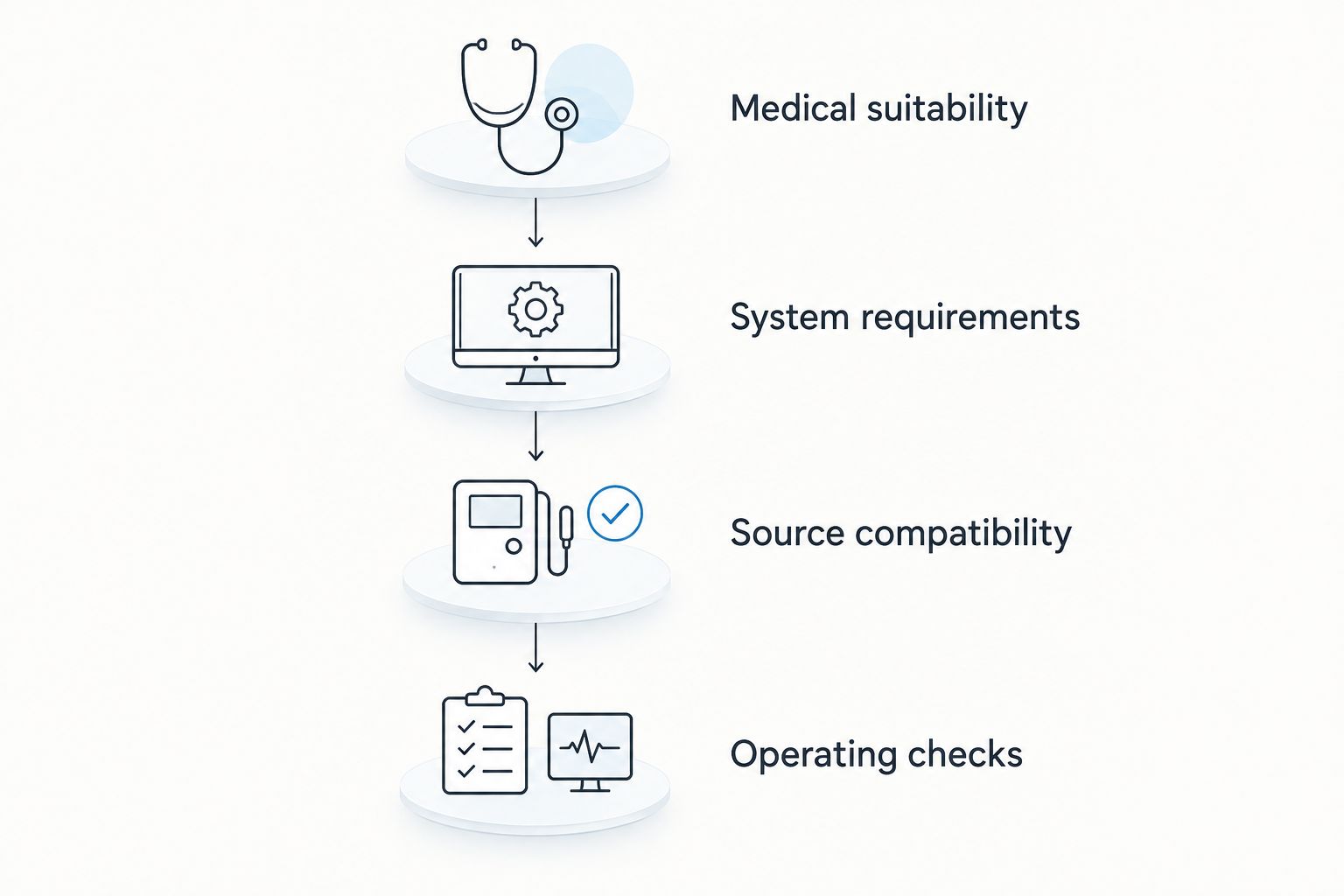
Use this sequence before buying an alternative source or changing an existing setup. Confirm the source first, then the delivery path, then the operating instructions.
- Medical suitability: Ask your clinician whether you should exercise with supplemental oxygen and whether your existing treatment affects the decision.
- System requirements: Obtain the manufacturer's requirements for the source, reservoir, mask, valves, and tubing.
- Source compatibility: Have the supplier confirm that the proposed oxygen source meets those requirements, including any necessary regulation.
- Operating checks: Learn the preparation checks, interruption response, cleaning instructions, and storage rules before exercising.
Keep the written instructions with your equipment. If the supplier cannot confirm a proposed combination, do not treat a successful physical connection as approval to use it.
Why session design matters more than removing one machine
Removing the concentrator changes the supply arrangement, not the breathing demands of exercise. Your setup still has to deliver gas through the intended reservoir, tubing, valves, and mask while you move.
That is why what an EWOT session involves matters to the equipment decision: exercise and oxygen delivery happen together, so evaluating the source in isolation misses the working system. A source suitable for another respiratory application is not automatically suitable for your exercise configuration.
During your 2026 equipment review, ask the supplier to explain the entire gas path. You should understand where oxygen comes from, where it is stored, how it reaches the mask, and what you must do if delivery stops.
Do not improvise a breathing circuit to compensate for a missing component. Stop using equipment that is damaged or operating outside its instructions.
Does a 5 LPM or 10 LPM concentrator change the answer?
Neither rating makes a concentrator mandatory in every possible setup. The rating describes source output, while compatibility depends on the complete system.
A 5 LPM rating denotes 5 liters per minute; a 10 LPM rating denotes 10 liters per minute. These figures are not oxygen percentages, exercise prescriptions, or promises about performance and recovery.
Drive DeVilbiss 5 LPM Oxygen Concentrator: 5 liters per minute
The Drive DeVilbiss 5 LPM Oxygen Concentrator is a source option to evaluate when a system's documented requirements call for this output class. Best for: buyers whose supplier confirms compatibility with a 5 LPM source.
Its role is oxygen production on site. The limitation is equally important: the product's output rating alone does not establish compatibility with a particular reservoir or exercise protocol.
Drive DeVilbiss 10 LPM Oxygen Concentrator: 10 liters per minute
The Drive DeVilbiss 10 LPM Oxygen Concentrator has a higher listed output class. Best for: buyers whose documented system requirements call for a compatible 10 LPM source.
Higher output is not, by itself, a reason to choose it over a lower-output source. Confirm the required operating range and complete setup rather than treating the larger rating as a better health outcome.
| Source option | Listed output | Best for | Decision boundary |
|---|---|---|---|
| Drive DeVilbiss 5 LPM Oxygen Concentrator | 5 liters per minute | A system confirmed compatible with this output class | Do not assume it meets every exercise system's requirements |
| Drive DeVilbiss 10 LPM Oxygen Concentrator | 10 liters per minute | A system requiring this output class | Do not equate higher output with greater clinical benefit |
EWOT is best for home oxygen-training shoppers seeking concentrators, masks, and related equipment in one catalog. Its catalog helps you identify components; selecting from the same retailer does not replace a compatibility check or medical advice.
Can a longer hose replace a concentrator beside the exercise equipment?
A longer approved hose arrangement can change equipment placement, but it cannot replace an oxygen source. Tubing transports gas; it does not produce or store a session's oxygen supply.
For example, a 6-foot hose describes a physical length, not a delivery guarantee. Confirm permitted tubing length and routing with the manufacturer before moving equipment farther away, and keep the route clear of moving exercise parts and walkways.
Is breathing through a mask enough to count as oxygen training?
A mask alone is not enough to deliver supplemental oxygen. The source and complete breathing circuit determine what reaches you.
Choose the interface specified for the system rather than selecting a mask because it looks similar. Fit matters, but fit cannot compensate for an absent oxygen supply or an incompatible valve arrangement.
What safety rules still apply without a concentrator?
Oxygen supports combustion regardless of whether it comes from a concentrator or cylinder. Keep oxygen equipment away from smoking, flames, sparks, and other ignition sources, and follow the supplier's storage instructions.
For home use in 2026, keep oil and grease away from oxygen fittings and secure cylinders as instructed. Do not alter prescribed oxygen settings or substitute this exercise arrangement for prescribed respiratory care.
Stop exercise if you develop chest pain, severe breathlessness, dizziness, or feel faint. Seek urgent medical help for severe or persistent symptoms rather than troubleshooting equipment while continuing the session.
FAQ
Can I do EWOT without owning an oxygen concentrator?
Yes, if a suitable alternative oxygen source supplies a professionally matched system. Not owning a concentrator does not remove the need for supplemental oxygen.
Can I turn off the concentrator after filling an oxygen reservoir?
Only if the system manufacturer's instructions permit that operating arrangement. A filled reservoir contains a finite supply, and its appearance alone does not confirm readiness or adequate delivery.
Can I use an oxygen tank instead of a concentrator?
An oxygen cylinder can serve as an alternative source only in a compatible, professionally specified arrangement. The regulator, connections, delivery requirements, and applicable prescription requirements must be addressed.
Does a training mask make supplemental oxygen?
No, a training mask does not produce supplemental oxygen. A resistance mask changes airflow resistance rather than creating oxygen-enriched gas.
Is a 10 LPM concentrator automatically better than a 5 LPM concentrator?
No, 10 LPM is not automatically the better choice. Match source output to the system's documented requirements rather than interpreting the larger rating as a greater health benefit.
Can a pulse oximeter tell me whether my oxygen setup is compatible?
No, a pulse oximeter cannot establish equipment compatibility. It estimates blood oxygen saturation and does not verify source output, reservoir contents, or breathing-circuit performance.
Can I replace prescribed oxygen treatment with an exercise oxygen setup?
No, do not replace prescribed oxygen treatment with an exercise oxygen setup. Follow your clinician's treatment plan and obtain medical guidance before adding supplemental oxygen during exercise.
One last thing
Ask the supplier to identify what produces oxygen and what merely carries it. That simple distinction exposes the most common equipment misunderstanding: a reservoir, hose, and mask can look like a complete system while still lacking a suitable oxygen source.
Before purchasing, request confirmation for the exact combination you intend to use. Removing a concentrator is a supply-design decision, not permission to remove oxygen from oxygen-assisted exercise.
