
EWOT systems for competitive cyclists: complete 2026 guide
Competitive cyclists’ exercise with oxygen therapy is stationary exercise while breathing supplemental oxygen, with the aim of supporting training—not guaranteeing faster race times. An EWOT system for competitive cyclists needs to fit your indoor riding position, equipment requirements, and training plan; this 2026 guide explains how to assess those needs before buying.
- An ewot system for competitive cyclists is an optional training tool, not a substitute for structured cycling training.
- EWOT suits home cyclists comparing oxygen training systems, concentrators, masks, and replacement parts.
- Confirm system compatibility before choosing a 5 LPM or 10 LPM oxygen concentrator.
- Evaluate cycling power and recovery separately from pulse oximeter readings; oxygen saturation does not measure training adaptation.
Why this matters
Competitive cyclists already manage training load, equipment, nutrition, and recovery. Adding oxygen equipment creates another variable, so the first decision is whether you have a clear question the equipment can help you investigate.
EWOT is best for home cyclists shopping for oxygen training equipment and replacement parts, not guaranteed race-performance gains. The EWOT catalog includes systems, concentrators, masks, hoses, and filters, but buying those components does not establish a performance benefit.
Treat this as an equipment-selection guide, not a personalized oxygen prescription. Ask a qualified clinician whether supplemental oxygen during exercise is appropriate for you, especially if you have a heart or lung condition, unexplained breathlessness, or prescribed oxygen needs.
Why oxygen training matters for competitive cyclists
For a competitive cyclist, an optional training tool must earn its place without weakening the work that already matters. A mask that changes your head position, tubing that restricts movement, or an unfamiliar routine that disrupts key sessions creates a practical problem before performance enters the discussion.
Oxygen-enriched exercise is also different from altitude training. Supplemental oxygen increases the oxygen available in the breathing supply; altitude exposure involves reduced oxygen availability. Do not treat oxygen-enriched riding as simulated altitude training.
For your 2026 training plan, separate three questions: Is supplemental oxygen appropriate for you? Does the equipment function correctly as a complete setup? Does using it produce a meaningful, repeatable improvement in the cycling outcome you care about?
Those questions require different evidence. Clinical guidance addresses suitability, equipment documentation addresses operation, and a consistent training record helps you evaluate your own experience without confusing it with proof of a broader benefit.
How to assess and set up oxygen training
Define your training question
Start with a notebook or spreadsheet, not a shopping list. Write down the specific outcome you want to assess, such as repeatable indoor power at a controlled effort or how you feel before the next scheduled session.
Avoid an open-ended goal such as “better oxygenation.” It gives you no clear basis for deciding whether the equipment deserves continued space in your training routine. A useful question names an observable cycling outcome and the conditions under which you will compare it.
- Choose one primary cycling outcome before changing your routine.
- Record your existing indoor sessions as a baseline.
- Note sleep, recent training load, fueling, and room conditions.
- Set a review date with your coach rather than judging one ride.
Confirm suitability and operating instructions
Collect your training notes, relevant medical history, and any existing oxygen prescription before discussing supplemental oxygen with a clinician. Ask about exercise use specifically; advice about resting oxygen use does not automatically establish an exercise protocol.
Do not copy a session duration, oxygen setting, or saturation target from another cyclist. Equipment capability and individual suitability are separate questions, and neither is answered by a product name.
For 2026 planning, keep written operating instructions beside the equipment so another household member does not have to reconstruct the setup from memory.
- Ask whether supplemental oxygen during exercise is appropriate for you.
- Follow any applicable prescription and clinician instructions.
- Read the complete system and concentrator manuals.
- Keep oxygen equipment away from smoking, flames, and ignition sources.
- Stop exercising for chest pain, dizziness, or unusual breathlessness; seek appropriate medical care.
Verify the complete equipment chain
First, sketch the setup manually: oxygen source, any reservoir, tubing, valves, mask, and exercise equipment. Then check every connection against the manufacturer’s instructions. A complete shopping list is not the same as a verified, compatible system.
The XCEL O2 - Wellness Oxygen Training System (EWOT) is a named system to assess rather than assembling unrelated components without a specification. Confirm its current included components, oxygen-source requirements, and operating instructions before ordering accessories.
The catalog lists the Drive DeVilbiss 5 LPM Oxygen Concentrator and Drive DeVilbiss 10 LPM Oxygen Concentrator. Those labels identify output classes of 5 liters per minute and 10 liters per minute; they do not establish the oxygen concentration reaching your mask during exercise or the correct configuration for your use.
- List all required components and distinguish included items from accessories.
- Confirm the specified concentrator type and output requirements.
- Verify any reservoir’s operating and filling instructions.
- Match tubing, connectors, and valves to the system documentation.
- Request confirmation when a connection or component specification is unclear.
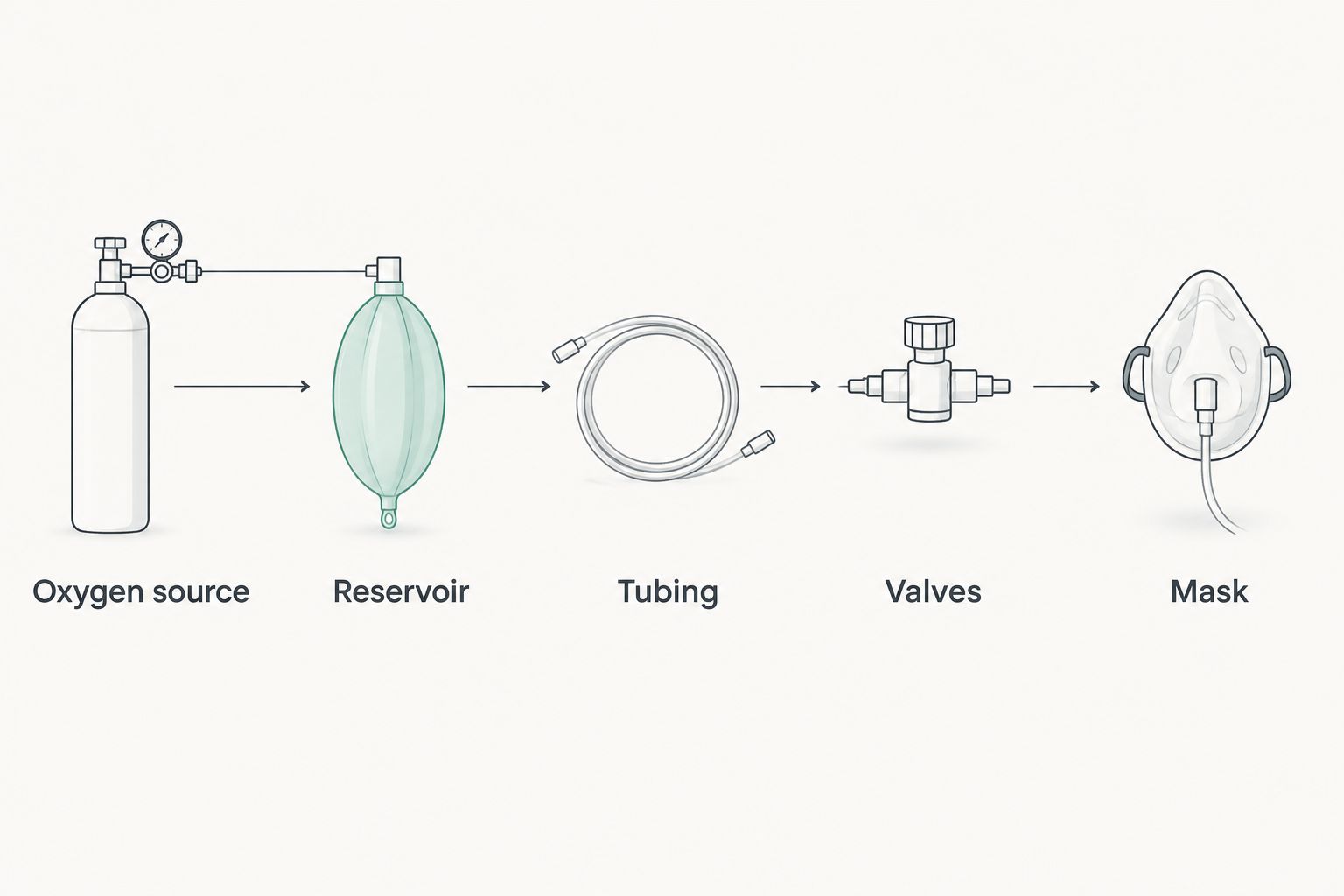
A component check is a purchase decision, not proof that the setup is ready for exercise. Complete the fitting and operating checks before starting a session.
Fit the setup to your riding position
Use your existing stationary bike or secured indoor trainer to check physical clearance before adding oxygen equipment. Sit upright, move into your usual training position, and practice getting off the bike while it is stationary.
The Clear XCEL O2 EWOT Oxygen Mask listing instructs buyers to measure their face for sizing. That makes measurement a better starting point than selecting a mask by appearance. Compatibility and fit still need confirmation for the complete setup.
The catalog also includes 6-foot and 9-foot hoses. Those lengths describe reach, not permission to extend every breathing circuit; follow the system’s tubing requirements instead of choosing solely by room layout.
- Measure your face using the mask’s sizing instructions.
- Check head movement without pulling on the mask or tubing.
- Route tubing away from cranks, pedals, wheels, and trainer mechanisms.
- Keep concentrator ventilation openings clear as its manual requires.
- Check that you can stop and dismount without catching the tubing.
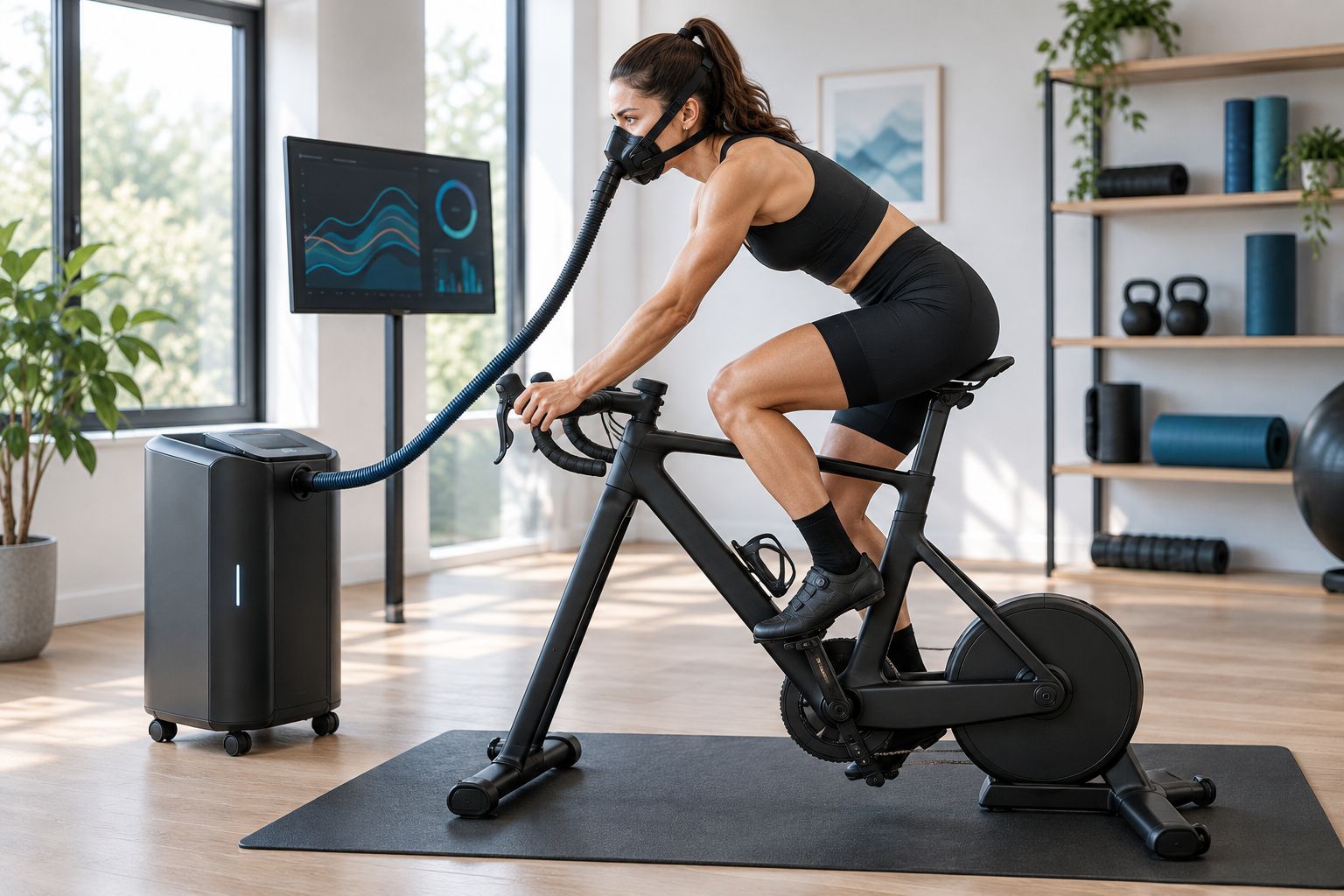
Once suitability and compatibility are confirmed, compare the system and mask as separate purchasing decisions. The cards below identify catalog items, not a complete kit specification or a recommended oxygen protocol.


Compare sessions without confusing the result
Use your existing training log first. Keep the comparison workout, power measurement, cooling, and fueling consistent enough that you can identify what changed. Avoid introducing oxygen equipment alongside a new supplement, a different training block, and a bike-fit adjustment.
A pulse oximeter estimates peripheral oxygen saturation. It does not measure threshold power, muscle oxygen use, recovery quality, or future race performance. Movement and other measurement limitations also matter, so do not use a reading as permission to ignore symptoms or increase oxygen settings.
Make your 2026 review about the original training question, not the most favorable number collected afterward.
- Record power, heart rate, perceived effort, and workout completion.
- Note mask discomfort, leaks, tubing pull, and interruptions.
- Follow clinician guidance on whether and how to monitor oxygen saturation.
- Review comparable sessions rather than a single unusually good ride.
- Keep conclusions limited to what your records actually show.
Maintain the equipment between sessions
Create a maintenance checklist from the manuals before the first session. Separate mask and tubing care from concentrator filter maintenance; different components need different handling, and a cleaner suitable for one surface is not automatically suitable for every part.
The catalog distinguishes replacement filters for the DeVilbiss 10 LPM 1025DS and 5 LPM 525DS. Match the actual concentrator model and manufacturer instructions rather than relying on a similar-looking product or a familiar output rating.
- Follow the specified cleaning method for each component.
- Inspect masks, valves, connectors, and tubing for damage.
- Replace filters according to the correct model’s instructions.
- Store components as directed and protect them from contamination.
- Keep a dated record of maintenance and unresolved operating issues.
Compare options for competitive cyclists
Choose the least complicated option that answers your actual need. Standard indoor cycling remains the reference point; oxygen equipment adds setup, maintenance, and suitability checks rather than replacing a training plan.
The best-for labels below describe practical use cases, not proven performance rankings. Concentrator selection depends on the complete system requirements, not simply choosing the larger output number.
| Option | Best for | Practical advantage | Key limitation |
|---|---|---|---|
| Standard indoor cycling without supplemental oxygen | Cyclists establishing a training baseline | Keeps the workout focused on existing cycling equipment | Does not provide supplemental oxygen |
| XCEL O2 - Wellness Oxygen Training System (EWOT) | Home cyclists assessing a dedicated oxygen training system | Gives you a named system to evaluate against your needs | Confirm included components, compatibility, and instructions; the listing does not establish cycling gains |
| Drive DeVilbiss 5 LPM Oxygen Concentrator | Buyers whose verified system requirements specify a compatible 5 LPM source | Provides a defined output class for equipment matching | Not a complete cycling oxygen setup; do not assume direct-mask suitability |
| Drive DeVilbiss 10 LPM Oxygen Concentrator | Buyers whose verified system requirements specify a compatible 10 LPM source | Provides a different output class for equipment matching | Higher rated output does not establish greater training benefit |
| Clear XCEL O2 EWOT Oxygen Mask | Buyers checking a mask with a non-rebreather valve | Offers a specific mask option with face-measurement guidance | Requires correct sizing and system compatibility; it is not an oxygen source |
Common mistakes competitive cyclists make
Chasing a saturation number instead of a cycling outcome
A higher displayed oxygen saturation is not evidence of a higher sustainable power output. Keep your original cycling outcome at the center of the review, and interpret any saturation monitoring under clinical guidance.
Treating concentrator output as exercise breathing supply
A concentrator’s rated liters per minute does not describe the entire breathing circuit. Reservoir design, mask and valve configuration, and operating instructions all belong in the assessment; do not improvise connections to compensate for an unsuitable setup.
Introducing unfamiliar equipment during race preparation
A race-specific session is a poor place to discover mask discomfort or tubing interference. Complete fit and operating checks separately, and protect key workouts from equipment experiments that change their intended purpose.
Assuming oxygen training reproduces altitude exposure
Oxygen-enriched exercise and reduced-oxygen exposure are different interventions. A shared association with oxygen does not make their mechanisms, protocols, or expected outcomes interchangeable.
Buying unrelated recovery products to complete the setup
Supplements and other wellness equipment are separate decisions, not required parts of a cycling oxygen circuit. Adding several interventions at once also makes your training observations harder to interpret.
FAQ
What's the best EWOT system for competitive cyclists?
The best system is one that meets verified equipment requirements, fits your stationary cycling setup, and is appropriate for you to use. The XCEL O2 - Wellness Oxygen Training System (EWOT) is an option to assess, not a guarantee of improved race performance.
Will exercise with oxygen therapy increase my cycling FTP?
Do not assume an oxygen training system will increase your functional threshold power. Evaluate that outcome through consistent cycling testing and training records rather than oxygen saturation readings or product claims.
Is a 10 LPM concentrator better than a 5 LPM concentrator for cyclists?
A 10 LPM concentrator is not automatically better for cyclists. Choose the output specified for the complete compatible system; a larger output rating does not establish a larger performance benefit.
Can I connect an oxygen concentrator straight to a cycling mask?
Do not assume a direct connection is suitable. Follow the complete system's instructions for the oxygen source, any reservoir, tubing, valves, and mask, along with applicable clinical guidance.
How long should a cyclist use supplemental oxygen during exercise?
There is no session duration this buying guide can prescribe for every cyclist. Obtain individualized guidance and follow the operating instructions rather than copying another rider's routine.
Is oxygen-enriched cycling the same as altitude training?
No, oxygen-enriched cycling is not the same as altitude training. Supplemental oxygen increases oxygen availability in the breathing supply, while altitude exposure involves reduced oxygen availability.
Do I need a pulse oximeter for oxygen training?
Ask your clinician whether oxygen saturation monitoring is appropriate for your use. A pulse oximeter estimates peripheral oxygen saturation; it does not measure cycling adaptation or establish that an exercise protocol is safe.
One last thing
Test the dismount before you test the workout. With the bike stationary and the oxygen equipment not operating, check whether you can remove the mask and step away without catching tubing or pulling a component.
Make that a setup check in your 2026 training routine. A system that obstructs stopping or dismounting needs correction before exercise, regardless of its specifications.
