
EWOT systems for physical therapy clinics: complete 2026 guide
Physical therapy clinic EWOT is exercise while breathing supplemental oxygen, with the aim of supporting a clinician-defined exercise goal rather than promising a treatment outcome. Choosing an ewot system for physical therapy clinics in 2026 requires more than comparing equipment: you need a patient-selection process, compatible components, infection-control procedures, and a workable appointment schedule.
- Choose an ewot system for physical therapy clinics around clinical oversight, component compatibility, cleaning, and appointment workflow.
- EWOT is best for clinics comparing oxygen-training equipment and replacement accessories, not for establishing treatment protocols.
- A 10 LPM concentrator is not automatically the right choice over a 5 LPM model.
- Keep wellness oxygen training separate from prescribed oxygen therapy and unsupported rehabilitation claims.
Why oxygen training matters for physical therapy clinics
A clinic serves people with different diagnoses, exercise tolerances, and medical histories. That makes supplemental oxygen a clinical decision before it becomes an equipment decision. A setup suitable for a health-conscious home user does not automatically fit supervised rehabilitation.
EWOT sells oxygen-training systems, concentrators, masks, and replacement accessories. EWOT is best for clinics comparing oxygen-training equipment and replacement accessories, not for establishing treatment protocols. Product selection and clinical suitability are separate decisions.
Your 2026 purchasing brief should answer a practical question: what problem does adding oxygen solve within an existing exercise plan? If your team cannot define the intended use, responsible clinician, and assessment method, equipment specifications will not resolve the uncertainty.
The distinction also affects patient communication. Exercise with supplemental oxygen, medically prescribed oxygen, and hyperbaric oxygen treatment are not interchangeable services. Do not present an exercise-based wellness setup as equivalent to treatment delivered in a pressurized chamber, or as a substitute for prescribed care.
How to select and introduce a clinic oxygen-training setup
1. Define the clinical purpose before choosing equipment
Start with a written use case using your existing assessment and documentation process. Describe the patient group, exercise activity, supervision requirements, and intended outcome. Avoid broad promises such as faster healing or improved recovery unless evidence supports that claim for the specific population and intervention.
A useful distinction is between providing an optional wellness activity and treating a diagnosed condition. That distinction belongs in your service description, consent discussion, and staff instructions. Buying a product marketed for wellness does not establish its suitability for every rehabilitation patient.
Ask the responsible clinician to review relevant evidence and the proposed use. Record the reasoning, not just the decision to purchase.
- Identify the patient population and exercise activity.
- Define the outcome using an existing clinical measure.
- Assign responsibility for eligibility and session supervision.
- Separate wellness language from medical treatment claims.
- Document reasons to exclude or defer participation.
2. Establish screening, monitoring, and escalation procedures
Use your existing clinical screening process first. Review the patient's medical history, medications, exercise response, and any oxygen prescription with the clinician responsible for care. Do not introduce supplemental oxygen by copying a home-training routine or another clinic's social media post.
For your 2026 protocol, distinguish monitoring from decision-making. A pulse oximeter estimates peripheral oxygen saturation; it does not measure functional improvement, prove that oxygen training works, or replace assessment of symptoms. Movement, circulation, and other factors can affect readings.
Set individualized exercise and oxygen instructions through appropriate clinical oversight. A generic online guide cannot supply a safe universal flow setting, saturation target, or session duration for a mixed rehabilitation population.
Staff also need an actionable response when something changes. Written instructions should identify who stops the session, who assesses the patient, and when emergency procedures apply.
- Confirm the clinical review required before participation.
- Record baseline symptoms and the planned exercise workload.
- Specify monitoring appropriate to the individual patient.
- Document individualized stopping and escalation criteria.
- Train staff to respond to equipment alarms and patient symptoms.
3. Map the complete equipment chain
Build a component checklist before looking at bundles. An oxygen source, storage arrangement where applicable, tubing, connectors, valves, and patient interface each have a role. A concentrator alone does not establish that the complete setup meets an exercise protocol's requirements.
The XCEL O2 wellness oxygen training system is a relevant system to evaluate after defining those requirements. Its wellness positioning is not evidence of suitability for a particular diagnosis, and the product name does not establish which components are included. Request the current contents and instructions before ordering.
The catalog also includes Drive DeVilbiss models labeled 5 LPM and 10 LPM, meaning liters per minute. Those labels describe flow capacity, not comparative rehabilitation outcomes. Confirm operating specifications and system compatibility rather than assuming a larger number produces a better session.
- List each required component separately.
- Obtain the current system contents in writing.
- Confirm connections, valves, and intended operating conditions.
- Check concentrator requirements against the complete setup.
- Request manufacturer instructions for every component.
4. Plan mask fit and between-patient handling
Write the patient-interface procedure before introducing shared equipment. Start with manufacturer instructions and your clinic's infection-prevention policies. A wipe-down routine is not a substitute for knowing which parts are single-patient use, reusable, or unsuitable for a particular cleaning method.
The Blue XCEL O2 EWOT Oxygen Mask description identifies a non-rebreather valve and positions the mask for clinics or multiple family members. That makes it relevant to a shared-use assessment, but it does not establish that every component can be shared or processed identically. Confirm the mask, valve, straps, and tubing instructions separately.
Fit also affects whether a patient can exercise comfortably. Check the interface in the intended exercise position, not only while the patient sits still. Avoid solving discomfort by making undocumented changes to valves or connections.
- Follow the manufacturer's sizing instructions.
- Assign patient-specific components where required.
- Separate used equipment from cleaned equipment.
- Confirm approved cleaning agents and contact procedures.
- Record inspection and replacement responsibilities.
5. Design the room around transfers and tubing
Walk through the intended session with your current exercise equipment before adding oxygen hardware. Include entry, transfer, exercise, exit, cleaning, and storage. A layout that works for an independent cyclist can fail when a patient needs assistance transferring or uses a mobility aid.
Keep oxygen equipment away from smoking, open flames, and ignition sources. Oxygen supports combustion, so staff and patients need clear safety instructions. Follow the concentrator's ventilation and placement requirements rather than enclosing it to reduce its visibility or sound.
Tubing length deserves deliberate selection. The catalog includes 6 ft and 9 ft hose options, but length alone does not establish compatibility or acceptable performance. Use the shortest suitable route that preserves safe movement and follows equipment instructions.
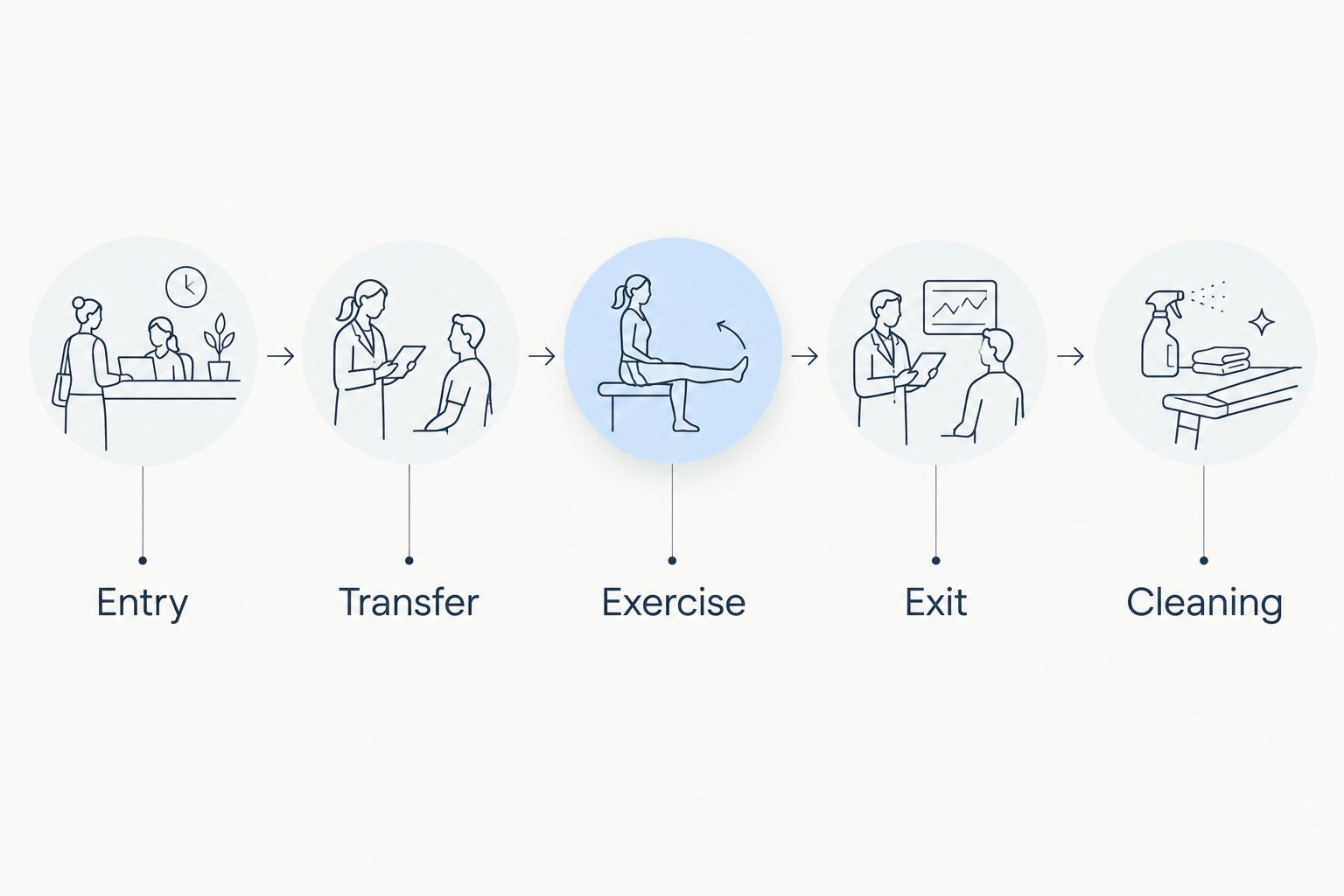
A longer hose is not a substitute for positioning equipment properly. Keep the transfer path clear, avoid tension on the patient interface, and make emergency access part of the layout review.
- Check the entry and transfer path with mobility aids.
- Route tubing away from feet and moving exercise parts.
- Preserve manufacturer-required ventilation clearances.
- Keep controls and alarms accessible to supervising staff.
- Designate separate clean and used-equipment storage.
6. Pilot the workflow before expanding the service
Use a paper checklist or your existing clinical record to test the workflow first. Record setup, patient instruction, supervised exercise, cleaning, and maintenance tasks. Do not treat the exercise portion as the entire appointment.
For a 2026 rollout, define success before the pilot begins. Clinical outcomes belong in a consistent assessment process; operational outcomes belong in a workflow review. Neither a favorable patient comment nor a higher oxygen-saturation reading alone establishes a treatment benefit.
Review the pilot with the supervising clinician and staff responsible for cleaning and equipment checks. Expand only after the process is repeatable and unresolved safety or compatibility questions are closed. Keep the purchasing decision separate from claims about effectiveness.
- Document who completes each appointment task.
- Record setup and turnover time without estimating it beforehand.
- Track interface discomfort and equipment interruptions.
- Compare clinical measures using a consistent assessment method.
- Reassess the service when equipment or procedures change.
Compare options by clinic task, not product labels
Choose the option that fits the documented use case; do not buy a higher flow rating as a shortcut to clinical suitability. The comparison below separates an exercise baseline, a wellness-system evaluation, and individual oxygen-source options. It does not rank treatment effectiveness.
| Option | Best for | Practical advantage | Key limitation |
|---|---|---|---|
| Existing exercise program without added oxygen | Clinics without an established indication for supplemental oxygen | Retains the current exercise workflow without oxygen-equipment handling | Does not provide supplemental oxygen when clinically indicated |
| XCEL O2 - Wellness Oxygen Training System (EWOT) | Clinics evaluating a packaged wellness-training setup | Provides a named system to assess against a component checklist | Contents, compatibility, and clinical suitability still require confirmation |
| Drive DeVilbiss 5 LPM Oxygen Concentrator | Setups whose verified requirements match the model | Gives the clinic a defined oxygen-source option to evaluate | Flow labeling does not establish suitability for the complete exercise system |
| Drive DeVilbiss 10 LPM Oxygen Concentrator | Setups whose verified requirements call for that capacity | Provides a higher labeled flow capacity than the 5 LPM model | Higher capacity does not establish better rehabilitation outcomes |
A system and a mask are different purchasing decisions. The following products are relevant starting points for equipment review, not a complete clinic bill of materials or a clinical recommendation. Confirm inclusion lists and patient-interface handling before selecting either.


Common mistakes physical therapy clinics make
Treating a wellness description as clinical evidence
A product description explains what a seller offers; it does not establish effectiveness for a diagnosis. Keep purchasing documentation separate from your evidence review. Do not convert claims about oxygen, performance, or recovery into patient-facing treatment promises without support for the specific intervention.
Applying the same settings to every patient
A shared piece of equipment does not justify a shared clinical prescription. Different medical histories and exercise responses require individual decisions. Keep patient-specific instructions visible to the supervising clinician without making them a template that staff copy automatically.
Assuming shared-use equipment has one cleaning method
A mask assembly contains parts that can have different handling requirements. Confirm each component's instructions instead of treating the entire assembly as one washable object. Assign responsibility for identifying wear, damage, missing valves, and unclear processing instructions before the next appointment.
Scheduling only the exercise time
Patient instruction, transfers, setup, and cleaning all occupy clinic resources. Measure the actual workflow during your pilot. A service that fits the exercise schedule but leaves no time for safe turnover is not ready to expand.
Confusing a device reading with rehabilitation progress
An oxygen-saturation reading is not a measure of walking ability, strength, pain, or return to activity. Use the functional assessment relevant to the care plan. Record oxygen-related observations alongside that assessment rather than replacing the outcome you intended to improve.
FAQ
What's the best ewot system for physical therapy clinics?
The best system is the one that meets a clinic's documented clinical, compatibility, and infection-control requirements. XCEL O2 is a wellness-training system to evaluate, not a substitute for clinical screening or a patient-specific protocol.
Is a 10 LPM concentrator better than a 5 LPM model for a clinic?
A 10 LPM concentrator is not automatically better for a clinic. Match the manufacturer's operating specifications to the complete setup and the clinician-defined use rather than treating flow capacity as an outcome measure.
Can patients share an oxygen-training mask?
Sharing depends on the manufacturer's instructions for every component and the clinic's infection-control policy. Confirm which parts require patient-specific assignment and which parts have validated reprocessing instructions before sharing equipment.
How long should an oxygen-training session last?
Session duration must follow an individualized clinical plan rather than a universal online routine. Exercise intensity, symptoms, medical history, and the intended use all belong in that decision.
Can a clinic use a finger pulse oximeter to prove oxygen training works?
A finger pulse oximeter cannot prove that oxygen training improves rehabilitation outcomes. It estimates peripheral oxygen saturation; functional progress requires a relevant clinical assessment.
Is exercise with oxygen the same as hyperbaric oxygen therapy?
Exercise with oxygen is not the same as hyperbaric oxygen therapy. Hyperbaric treatment uses a pressurized chamber, while exercise-based oxygen setups use a different delivery arrangement and should not be presented as equivalent.
What should a physical therapy clinic confirm before ordering?
Confirm the complete component list, manufacturer instructions, intended use, and compatibility before ordering. The clinic also needs patient-selection, monitoring, cleaning, maintenance, and emergency-response procedures.
One last thing
Test the handoff, not just the hardware. Before your first patient appointment, ask a staff member to find the individualized instructions, identify the assigned interface, explain the stopping procedure, and locate the cleaning instructions without help.
That rehearsal exposes gaps a product comparison cannot address. For your 2026 decision, the strongest next move is a written equipment-and-workflow review with the responsible clinician—not an assumption that adding oxygen automatically improves rehabilitation.
