
EWOT vs The CPAP Shop: which is better in 2026
Choose EWOT if you want equipment for exercise with supplemental oxygen at home; choose The CPAP Shop if you need equipment for prescribed positive airway pressure treatment during sleep. In 2026, the deciding factor is the job the equipment must do—not whether both retailers sell products connected to breathing.
- EWOT vs The CPAP Shop is an oxygen-training versus sleep-therapy decision, not a contest between interchangeable treatments.
- Choose the oxygen-training retailer for exercise equipment; choose The CPAP Shop for prescribed CPAP equipment.
- An oxygen concentrator supplies concentrated oxygen; a CPAP machine provides positive airway pressure.
- Match masks, tubing, filters, and maintenance instructions to the exact equipment before ordering.
Why this matters
Buying respiratory equipment by appearance creates the wrong comparison. A mask, hose, and powered device can form part of very different systems, with different purposes and operating requirements.
The XCEL O2 wellness oxygen training system belongs in an exercise-equipment comparison. Prescribed CPAP equipment belongs in a sleep-treatment comparison. Neither category is a substitute for the other.
For your 2026 purchase, establish the intended use before comparing individual products. If your clinician prescribed treatment for sleep apnea, start with that prescription rather than an oxygen-training shopping list.
At a glance
| Dimension | EWOT | The CPAP Shop |
|---|---|---|
| Best for | Home exercise with supplemental oxygen | Shopping for prescribed CPAP equipment |
| Standout offering | Oxygen-training systems and associated equipment | CPAP equipment for positive airway pressure therapy |
| Oxygen supply | Listed concentrator options include 5 LPM and 10 LPM models | A CPAP machine provides pressure, not oxygen concentration |
| Masks and tubing | Exercise-mask and oxygen-hose options | CPAP interfaces and tubing must match the prescribed setup |
| Compatibility | Exact component and model checks are essential | Exact component and model checks are essential |
| Maintenance | Follow each oxygen-system component's instructions | Follow each CPAP component's instructions |
| Purchase structure | Compare the system and any separately required components | Compare the prescribed device and required accessories |
| Clinical boundary | Exercise equipment does not replace prescribed sleep therapy | Sleep-therapy equipment is not an oxygen-training system |
The table compares purchasing purposes, not clinical effectiveness. A retailer's category fit does not establish that a particular device is appropriate for your health needs.
EWOT is the better fit for home oxygen-training equipment
EWOT is the better fit for consumers shopping for at-home oxygen-training equipment. Its stated product range includes exercise-with-oxygen systems, oxygen concentrators, masks, filters, and related wellness equipment.
That range addresses a specific shopping task: assembling or maintaining equipment for exercise with supplemental oxygen. It does not establish that every item works with every other item, or that any particular bundle contains all the components you need.
Your first question should be what you are replacing or building. An existing owner replacing a hose has a different shopping list from a first-time buyer choosing a complete setup.
- Best for: Home users researching oxygen-training equipment and replacement components.
- Advantage: The catalog directly includes the equipment category you are researching.
- Limitation: Product categories alone do not establish compatibility, clinical suitability, or exercise outcomes.
Keep the purchase focused. Supplements, vibration equipment, and other wellness products do not resolve an unanswered question about your oxygen system.
The CPAP Shop is the better fit for prescribed sleep therapy
Choose The CPAP Shop when your shopping task starts with a CPAP prescription. CPAP treats obstructive sleep apnea by maintaining positive airway pressure to help keep the upper airway open during sleep.
This is a different task from adding supplemental oxygen during exercise. Your prescription, device requirements, and mask fit should define the purchase—not an expectation that respiratory equipment performs the same function across categories.
A mask that looks comfortable in an exercise setting is not automatically an appropriate interface for your sleep-treatment device. The same caution applies to tubing and connectors.
- Best for: People obtaining equipment for prescribed positive airway pressure therapy.
- Advantage: The retailer's CPAP focus matches the sleep-equipment shopping task.
- Limitation: Choosing a CPAP retailer does not turn a CPAP machine into an oxygen concentrator or exercise-oxygen system.
If you already use CPAP and want to explore oxygen training, treat that as a separate conversation with your clinician. Do not change your sleep-treatment equipment or settings to imitate another modality.
Oxygen concentrators win on oxygen supply—not airway pressure
An oxygen concentrator separates oxygen from surrounding air to supply oxygen-enriched gas. A CPAP machine delivers positive airway pressure. Concentration and pressure are different functions.
The listed Drive DeVilbiss oxygen concentrators include 5 LPM and 10 LPM models. LPM means liters per minute: it describes flow, not a guaranteed oxygen concentration at the mask or a promised training benefit.
A larger listed flow figure does not answer every purchasing question. You still need the equipment's operating instructions, the requirements of the intended system, and confirmation that the components work together.
Use this distinction when comparing specifications:
- Oxygen supply: Check the concentrator's documented output and operating requirements.
- Airway pressure: Follow the prescribed positive airway pressure treatment and device instructions.
- Intended use: Confirm whether you are shopping for exercise equipment or sleep-treatment equipment.
Do not convert a flow figure into a pressure setting. These measurements describe different properties, and neither is a shortcut for deciding what your body needs.
The CPAP Shop wins when the mask must serve sleep treatment
For prescribed CPAP use, choose an interface intended for that treatment and compatible with your device. An exercise mask's appearance, strap arrangement, or product name is not enough to establish that fit.
The Clear XCEL O2 oxygen mask is listed as an exercise-with-oxygen mask with a non-rebreather valve. Its description also directs buyers to measure their face when choosing a size. Those details support an exercise-mask purchase, not a claim of CPAP compatibility.
A shared word such as mask does not make two interfaces interchangeable. Intended use, connection requirements, and valve or vent arrangements matter more than visual similarity.
For sleep therapy, discuss persistent leaks, discomfort, or difficulty tolerating your interface with your equipment provider or clinician. For exercise equipment, follow that system's mask-selection instructions instead of borrowing assumptions from CPAP.
This dimension has a clear winner only after you specify the task: the prescribed sleep interface for sleep treatment, and a documented compatible exercise interface for oxygen training.
Both require exact compatibility checks
Neither shopping route eliminates component matching. A connector that physically attaches is not proof that the resulting assembly is suitable for use.
The oxygen-training catalog includes 6 ft and 9 ft hose options, along with replacement filters tied to specific concentrator models. Those are purchasing identifiers, not permission to extend a setup indefinitely or substitute a filter across machines.
Before ordering a replacement, record these details:
- Device model: Copy the exact model identifier from your existing equipment.
- Component match: Confirm the specified mask, hose, connector, or filter.
- Maintenance instructions: Check how the manufacturer says to clean, inspect, and replace it.
- Intended use: Keep exercise equipment and prescribed sleep-treatment requirements distinct.
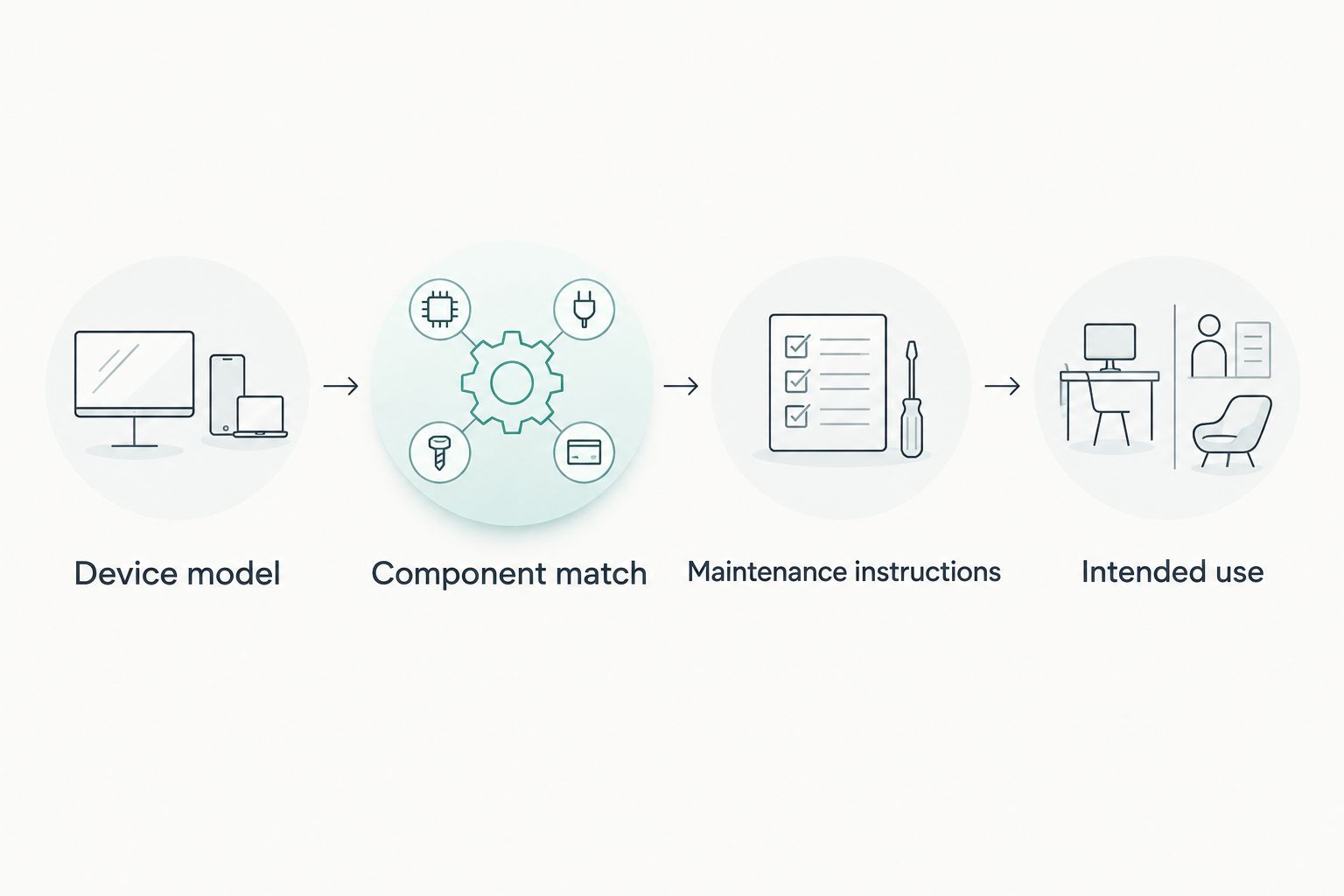
A photograph of the old part can help you communicate what you own, but it does not replace the model identifier. Compatibility is a tie: both purchasing routes require exact checks.
Both need a maintenance plan before purchase
Maintenance is part of equipment ownership, not an optional accessory decision. Masks, hoses, filters, and powered devices each have their own instructions; a cleaning method suitable for one component is not automatically suitable for another.
Before your 2026 purchase, establish which parts require routine cleaning, which are replaceable, and which require service. Use the manufacturer's schedule rather than inventing a universal replacement interval.
Keep these questions on your shopping list:
- Can you identify the correct replacement part without guessing?
- Do the instructions distinguish cleaning from disinfection?
- Are there restrictions on heat, chemicals, or sterilization methods?
- What should you do when a component is damaged or the device alarms?
Neither retailer earns a maintenance win merely because it sells accessories. The better purchase is the setup you can maintain according to its instructions. Avoid creating a mixed collection of parts whose care requirements you have not checked.
Oxygen training fits exercise goals; CPAP fits sleep-treatment goals
A training objective does not change what a device does. If your interest is cardiorespiratory fitness, separate the exercise plan, the supplemental-oxygen setup, and the method used to assess progress.
A workflow discussing EWOT training for VO2 max concerns exercise planning; it does not make an oxygen-training system a treatment for obstructive sleep apnea. Nor does the topic itself establish that a particular product increases your VO2 max.
A finger pulse oximeter estimates blood oxygen saturation. It does not measure VO2 max, diagnose sleep apnea by itself, or prove that an exercise session improved your fitness.
For a meaningful 2026 comparison, define the outcome before choosing equipment:
- Exercise goal: Decide what training activity and assessment method you will use.
- Sleep-treatment goal: Follow your clinician's treatment plan and prescribed equipment requirements.
- Equipment goal: Identify whether you need a complete setup, a replacement component, or professional troubleshooting.
Buy for the function you need, not for an unrelated measurement you hope will improve.
Compare complete purchases, not isolated product listings
The useful purchasing comparison is equipment ownership plus the components required for your intended setup. An individual mask listing and a system listing are not equivalent shopping baskets.
For oxygen training, request an itemized explanation of what the selected system includes and what must be obtained separately. For prescribed CPAP equipment, establish the required device, interface, tubing, and other prescribed or device-specific components before comparing totals.
Keep purchase terms separate from equipment suitability. A payment arrangement does not fix an incompatible mask, and an attractive equipment listing does not establish that a device satisfies your prescription.
For your 2026 decision, compare:
- The exact equipment and components included.
- Any required components outside the selected package.
- The replacement parts needed to maintain that setup.
- The seller's current purchase, return, and service terms.
A complete, compatible shopping list is more useful than a headline figure. Obtain the current terms directly from each seller before committing; do not assume the retailers use identical payment or service arrangements.
Final verdict: choose by treatment purpose
Choose EWOT if you are building a home oxygen-training setup
You are a health-conscious home exerciser researching supplemental-oxygen equipment, or an existing owner replacing a documented compatible component. EWOT wins for the oxygen-training shopping task. Confirm system contents and compatibility before ordering.
This recommendation concerns product-category fit. It is not a claim that exercise with oxygen treats a disease, replaces prescribed therapy, or guarantees recovery or performance gains.
Choose The CPAP Shop if you are buying prescribed CPAP equipment
You are a person with prescribed positive airway pressure treatment who needs an appropriate device, interface, or replacement component. The CPAP Shop wins for the CPAP shopping task. Let the prescription and device instructions define the purchase.
If you have both goals, keep separate equipment lists. Do not make one setup perform an undocumented second job.
| Dimension | Winner |
|---|---|
| Home oxygen-training equipment | Oxygen-training retailer |
| Prescribed CPAP equipment | The CPAP Shop |
| Supplemental oxygen supply | Oxygen concentrator category |
| Masks for prescribed sleep treatment | CPAP interface category |
| Compatibility checks | Tie: exact matching required |
| Maintenance planning | Tie: follow component instructions |
| Purchase structure | No universal winner: compare complete setups |
| Clinical purpose | Match the equipment to the intended use |
FAQ
Is EWOT better than The CPAP Shop?
EWOT is the better fit for shopping for home oxygen-training equipment; The CPAP Shop is the better fit for prescribed CPAP equipment. The deciding factor is exercise with supplemental oxygen versus positive airway pressure treatment during sleep.
Can exercise with oxygen replace my CPAP machine?
No, exercise with oxygen is not a substitute for prescribed CPAP treatment. Do not stop or change your sleep-apnea treatment without guidance from your clinician.
Is an oxygen concentrator the same as a CPAP machine?
No, an oxygen concentrator supplies oxygen-enriched gas, while a CPAP machine provides positive airway pressure. The devices perform different functions and are not interchangeable.
Should I choose a 5 LPM or 10 LPM oxygen concentrator?
Choose the flow capacity required by your intended system and its instructions. The listed flow alone does not establish compatibility, oxygen concentration at your mask, or suitability for a medical condition.
Can I use an exercise oxygen mask with my CPAP device?
Do not assume an exercise oxygen mask is compatible with a CPAP device. Use an interface specified for your device and prescribed treatment.
Does a pulse oximeter tell me my VO2 max?
No, a finger pulse oximeter estimates blood oxygen saturation rather than VO2 max. A saturation reading does not establish that an oxygen-training session improved fitness.
What should I compare before buying respiratory equipment in 2026?
Compare intended use, exact component compatibility, package contents, and maintenance requirements first. Then confirm the seller's current purchase and service terms for that specific setup.
One last thing
Before ordering, write the exact model number of every device you already own beside the replacement part you intend to buy. That simple pairing prevents a convincing product name from becoming a compatibility assumption. If you cannot establish the match from the instructions, ask before connecting it.
