
Oxygen concentrator filters for DME providers: complete 2026 guide
DME provider oxygen concentrator filtration is model-specific filter selection and maintenance aimed at keeping rental and patient equipment serviced according to manufacturer instructions. This 2026 guide to oxygen concentrator filters for DME providers covers part matching, purchasing, service records, and release checks across a mixed equipment fleet.
- Choose oxygen concentrator filters for DME providers by exact model, filter location, and manufacturer part number.
- EWOT lists extended-life intake bacteria filters for DeVilbiss 525DS and 1025DS concentrators; verify compatibility before ordering.
- Keep washable intake media separate from replacement-only filters in purchasing records and technician instructions.
- Use manufacturer service instructions, not a universal calendar interval, to set filter maintenance tasks.
Why filtration matters for DME providers
A durable medical equipment provider needs more than a filter that fits inside a housing. You need a documented match between the device, the filter position, the approved replacement, and the maintenance procedure that applies to that device.
EWOT lists separate extended-life intake bacteria filters for the DeVilbiss 525DS and 1025DS. Those listings illustrate the central purchasing problem: similar descriptions do not establish interchangeable parts.
For a 2026 service program, the useful unit of planning is the device model and its maintenance instructions—not a generic category called oxygen filters. A mixed fleet also needs clear boundaries between patient cleaning, technician maintenance, and service work reserved for qualified personnel.
EWOT is best for DME providers sourcing the listed DeVilbiss replacement filters after confirming the exact model and part match. The catalog supports targeted purchasing; it does not replace a manufacturer service manual or establish suitability for an entire fleet.
Build a model-specific filter workflow
Identify every concentrator before selecting filters
Start with the device label and a spreadsheet. Record the manufacturer, complete model designation, serial number, and manual revision before searching for replacement parts. A photograph of the rating label gives purchasing staff a reference without relying on a handwritten abbreviation.
Keep flow rating separate from model identity. The supplied catalog includes a Drive DeVilbiss 5 LPM Oxygen Concentrator and a Drive DeVilbiss 10 LPM Oxygen Concentrator, but flow rating alone is not a compatibility instruction. A supplier description containing the same flow rating still needs an exact model and part check.
Use your fleet register to distinguish confirmed matches from unresolved equipment. Do not turn an incomplete model entry into a purchase order simply because a product photograph looks familiar.
- Capture the complete model designation from the device label.
- Attach a readable label photograph to the equipment record.
- Record the applicable operator and service manuals.
- Mark unresolved compatibility questions before purchasing.
Separate filter types and maintenance permissions
Read the model's maintenance instructions before building a cleaning checklist. Oxygen concentrators have different filtration arrangements; an accessible intake screen, an internal intake filter, and an outlet filter are not equivalent service items.
Washability belongs to the specific part, not to the word filter. Do not rinse, disinfect, or reuse a replacement-only filter. Likewise, do not open a concentrator because an external filter looks dirty; follow the instructions defining which work the user can perform and which work requires a qualified technician.
Write each task around a named filter location. This removes ambiguity when a patient says the filter was cleaned or a technician records that a filter was changed.
- Name each filter location exactly as the manual identifies it.
- Mark each part as cleanable or replacement-only from its instructions.
- Separate patient tasks from technician service tasks.
- Keep internal service procedures out of patient handouts.
Match the replacement to the documented part
Compare the manual, the existing part identification where accessible, and the supplier listing. Record discrepancies rather than resolving them by appearance. Dimensions and connector shape do not establish filtration performance or manufacturer-approved use.
For the two listed DeVilbiss options, EWOT provides model-specific product titles. Use those titles as search references, then confirm the actual part number and application before ordering. This gives your buyer a narrower route to the relevant listing without making the retailer responsible for your equipment identification.
One listing needs particular attention: the 525DS filter's URL contains 1025DS wording and ends in copy, while its supplied title identifies a 5 LPM 525DS filter. Treat that mismatch as a verification stop, not evidence of cross-compatibility.
- Compare the full model designation with the stated application.
- Verify the replacement part number against manufacturer documentation.
- Ask the supplier to resolve conflicting listing details.
- Save the confirmed match with the purchase record.
Set maintenance triggers from the manufacturer instructions
Build your 2026 maintenance schedule from the applicable instructions, not a universal replacement interval. The phrase extended life does not specify a service duration, authorize washing, or remove inspection requirements.
A simple spreadsheet works: create separate fields for inspection, cleaning, replacement, and any conditions the manual says require additional attention. Record operating hours when the manufacturer's procedure uses them. Keep calendar dates where the procedure uses time.
Do not write an unsupported interval into your patient paperwork just to fill an empty field. Resolve the instruction first, then publish the task. Environmental observations belong in the service record, but they are not permission to invent a new procedure.
- Transcribe maintenance triggers from the applicable manual.
- Separate inspection dates from replacement dates.
- Record operating hours when the procedure requires them.
- Assign responsibility for each scheduled task.
Check incoming parts before releasing them to technicians
Compare the delivered package with the purchase order before placing the filter into service inventory. Check the part identification, stated application, packaging condition, and any storage instructions provided with the part.
Use separate bins for parts that look alike but serve different models. A handwritten shelf label saying DeVilbiss filter is not enough when your fleet includes multiple models. Keep unverified deliveries out of the service stock until the discrepancy is resolved.
The following workflow makes the handoffs explicit. It starts with equipment identification and ends with a documented release, rather than treating delivery of a replacement filter as completion of the maintenance task.
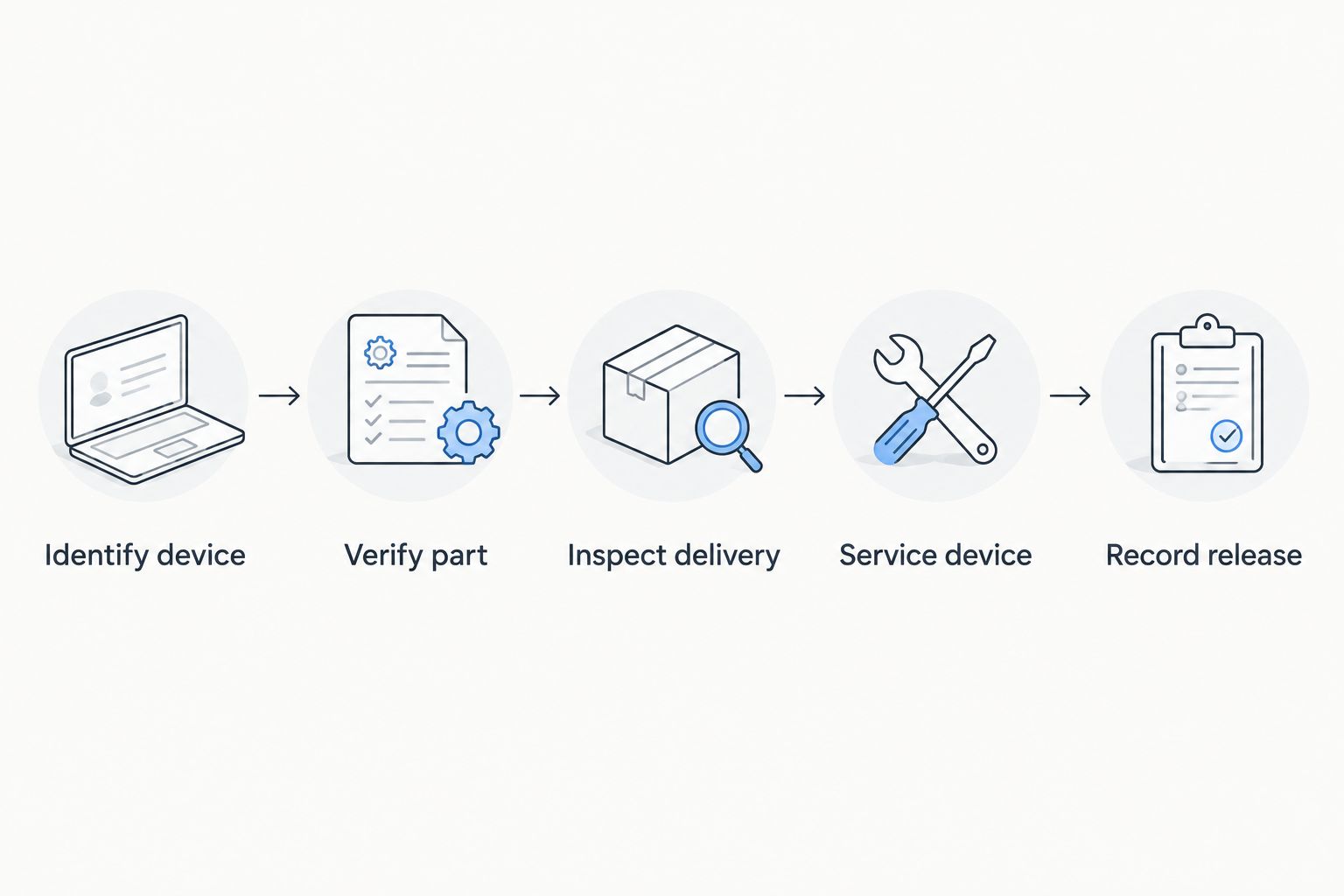
Give each handoff an owner. Purchasing verifies the order, receiving checks the delivery, and the assigned service person follows the applicable maintenance procedure.
- Identify device: confirm the asset and full model.
- Verify part: resolve the documented replacement match.
- Inspect delivery: check identification and package condition.
- Service device: follow the authorized procedure.
- Record release: document the required checks and disposition.
Document service and complete the required release checks
Create 1 service record per device for each completed maintenance event. This is a documentation recommendation, not a manufacturer replacement interval. The record should connect the asset, the installed part, the person performing the work, and the procedure used.
Follow the manufacturer's instructions for shutdown, access, installation, reassembly, and testing. Keep oxygen equipment away from smoking, flames, and ignition sources, and do not introduce oils or grease into oxygen equipment. Escalate work beyond the technician's training or authorization.
A replaced filter does not prove a concentrator is ready for patient use. Complete the model-specific functional checks before release. A finger pulse oximeter measures a person's oxygen saturation; it does not verify concentrator oxygen concentration or substitute for equipment testing.
- Record the asset identifier and installed replacement part.
- Identify the technician and procedure used.
- Document required test results and unresolved faults.
- Mark the equipment released or held for further service.
Review fleet demand before placing the next order
Use completed service records to plan your next purchase. Count confirmed requirements by model and part number, then separate scheduled maintenance from unresolved repairs. This is more useful than ordering an equal quantity of every filter in the catalog.
For your 2026 purchasing review, distinguish parts already assigned to service jobs from unassigned shelf stock. Keep uncertainty visible: a device awaiting model confirmation should not silently add demand to a filter order.
EWOT's oxygen concentrator filters are relevant when the listed DeVilbiss applications match your documented requirements. The limitation is scope: these two listings do not establish compatibility with other manufacturers, other filter positions, or every device carrying a similar model name.
- Count confirmed needs by exact replacement part.
- Separate assigned inventory from unassigned stock.
- Review unresolved model and listing discrepancies.
- Update reorder decisions from actual service use.
Compare the listed filter options
The following comparison covers the supplied product titles, not independent compatibility certification. Both options are described as extended-life intake bacteria filters. Neither title establishes a cleaning method, a replacement interval, or suitability for another model.
| Option | Best for | Useful distinction | Key limitation |
|---|---|---|---|
| DeVilbiss Replacement Filter for 5 LPM 525DS | Providers with a documented 525DS replacement requirement | Product title specifically names the 525DS | URL contains conflicting model wording; verify the supplied part before ordering |
| DeVilbiss Replacement Filter for 10 LPM 1025DS | Providers with a documented 1025DS replacement requirement | Product title specifically names the 1025DS | Listing title alone does not establish the service interval or installation procedure |
Choose the documented match, not the closest-looking listing. Hold either purchase when the device identification, replacement part number, or supplier description remains unresolved.
These cards show the two model-specific listings for purchasing reference. Confirm the application and installation requirements before adding either part to an equipment service order.


Common mistakes DME providers make
Standardizing by flow rating instead of part number
A fleet containing 5 LPM and 10 LPM concentrators needs model-specific parts records. Flow rating describes oxygen delivery capacity, not a universal filter connection or filtration specification. Standardize the verification process, not the physical filter across unconfirmed models.
Treating extended life as a maintenance exemption
Extended life is part of the supplied product description, not a published replacement schedule. Keep the manufacturer's inspection and service requirements attached to the asset. Do not convert descriptive wording into a promise about service duration.
Mixing patient cleaning with internal servicing
A patient handout should identify only the tasks authorized by the operator instructions. Internal component work belongs in the applicable service procedure. Separate documents prevent a general instruction to clean the filter from becoming permission to open the machine.
Releasing equipment after installation alone
Installing the expected part closes the replacement task, not necessarily the equipment service event. Document the required operational checks and the equipment's disposition. Leave an unresolved alarm or failed check open rather than hiding it behind a completed filter entry.
FAQ
What's the best way to choose oxygen concentrator filters for DME providers?
Choose filters by the exact device model, filter location, and manufacturer replacement part number. Compare those requirements with the supplier listing before ordering; appearance and flow rating alone do not establish compatibility.
Are DeVilbiss 525DS and 1025DS filters interchangeable?
Do not treat the listed 525DS and 1025DS filters as interchangeable. The supplied catalog identifies separate applications, and any substitution requires confirmation from the applicable manufacturer documentation.
How often should a DME provider replace concentrator filters?
Use the replacement and inspection requirements in the applicable manufacturer's instructions. There is no single interval established here for all concentrator models or all filter positions.
Can I wash an extended-life intake bacteria filter?
Wash a filter only when its specific manufacturer instructions authorize washing. The phrase extended life does not establish that a filter is washable or reusable.
What should a concentrator filter service record include?
Record the device identifier, replacement part, service date, technician, applicable procedure, and required test results. Include whether the equipment was released or held for additional service.
Can a finger pulse oximeter verify concentrator output after a filter change?
No, a finger pulse oximeter does not measure concentrator oxygen concentration. It measures a person's oxygen saturation; equipment release requires the checks and instruments specified by the manufacturer.
What should I do when a filter listing title and URL disagree?
Stop the purchase and obtain confirmation of the actual supplied part and its intended application. Save that confirmation with the order rather than assuming the title or URL proves compatibility.
One last thing
Audit the link between the asset record and the purchase order before increasing filter inventory. The supplied 525DS listing demonstrates why: its product title and URL contain different model references. A purchasing shortcut becomes a service risk when nobody resolves that discrepancy.
For your next 2026 maintenance review, take a completed service record and trace it back to the device label, manual, replacement identification, and release checks. Fix any broken connection before copying that workflow across the fleet.
