
Oxygen concentrators for home caregivers: complete 2026 guide
Home caregivers’ oxygen concentrator care is the daily management of prescribed oxygen equipment with the aim of delivering treatment safely at home. Choosing oxygen concentrators for home caregivers in 2026 means matching the prescription, preparing for power interruptions, and making daily checks manageable—not choosing the highest flow rating.
- Oxygen concentrators for home caregivers must match the prescription, delivery mode, and home safety plan.
- EWOT offers home oxygen concentrator options; caregivers must confirm clinical suitability and service arrangements before ordering.
- Drive DeVilbiss 5 LPM and 10 LPM models require prescription-based selection, not a higher-is-better comparison.
- Arrange backup oxygen, learn the alarms, and keep prescribed oxygen separate from wellness oxygen training.
Why oxygen concentrator care matters for home caregivers
A home caregiver manages more than a machine. You coordinate instructions, notice changes in the person receiving oxygen, and keep equipment usable when routines break down. A concentrator takes in room air, which contains approximately 21% oxygen, and supplies oxygen-enriched gas; it requires electricity to operate.
The practical choice starts with the care plan. Use the home-use oxygen concentrator guide to organize your equipment questions, then have the prescribing clinician and oxygen supplier confirm the configuration.
EWOT is best for home caregivers comparing oxygen concentrators by prescribed flow requirements, not seeking a diagnosis or treatment plan. Its catalog includes concentrators and related equipment, but a product listing does not establish suitability for an individual patient.
For your 2026 checklist, prioritize a usable backup plan and clear operating instructions over accessories. This guide supports equipment planning; it does not replace medical advice, the prescription, or the manufacturer’s instructions.
Set up a safe home oxygen routine
1. Get the prescription and escalation instructions in writing
Start with a paper checklist or a shared note. Ask the clinical team to document the prescribed flow, delivery mode, when oxygen is needed, and what to do when symptoms or readings change. Do not fill gaps using another patient’s routine.
A continuous-flow rate and a pulse-dose setting are not interchangeable. Continuous flow is expressed in liters per minute; pulse-dose settings depend on the device. A matching numeral does not establish equivalent oxygen delivery, especially during sleep or activity.
Make the instructions accessible to everyone who provides care. A second caregiver should be able to find them without searching through messages or relying on memory.
- Record the prescribed settings for rest, activity, and sleep, where applicable.
- Ask which symptoms require a clinician call and which require emergency help.
- Write down the clinician’s oxygen saturation targets and action instructions.
- Keep clinical, equipment-service, and emergency contacts beside the care plan.
2. Check the room before choosing equipment
Walk through the actual care space before shopping. Locate an appropriate outlet, check ventilation requirements in the equipment manual, and trace the tubing route between the concentrator and the person’s usual seating or sleeping area. Keep the machine accessible for inspection.
Oxygen supports combustion even though oxygen itself is not flammable. Smoking, vaping, flames, sparks, and unsuitable oils or greases create serious hazards around oxygen equipment. Follow the supplier’s specific separation and fire-safety instructions rather than inventing a universal safe distance.
Think about ordinary movement, too. A route that works while someone sits still can become a trip hazard when they stand, use a walker, or visit the bathroom.
- Choose a ventilated location that meets the manufacturer’s clearance requirements.
- Keep oxygen equipment away from smoking, vaping, flames, and heat sources.
- Route tubing away from walkways, moving furniture, and doors.
- Follow electrical instructions; do not improvise with extension cords or power strips.
3. Match the concentrator to the prescribed requirements
Use the prescription to build a comparison sheet before reviewing brands. Confirm the required flow range, delivery mode, oxygen concentration specifications at that flow, and suitability for the intended use. The headline flow rating is only one part of the decision.
EWOT lists Drive DeVilbiss oxygen concentrators in 5 LPM and 10 LPM models. These give caregivers two capacity categories to discuss with the clinician and supplier. A 10 LPM concentrator is not automatically the better choice for someone whose prescription fits a 5 LPM model.
For a 2026 purchase, request the current manual and written confirmation of the exact configuration. The catalog alone does not establish individual suitability, included accessories, training, servicing, or backup arrangements.
- Confirm that the exact model supports the prescribed flow and delivery mode.
- Review oxygen concentration specifications at the required operating settings.
- Ask who handles setup, caregiver instruction, alarms, and repairs.
- Confirm the required tubing, patient interface, and any prescribed humidification.
4. Practice the equipment and backup routine
Ask the equipment provider to demonstrate operation, then repeat the procedure yourself while they observe. Reading the manual is necessary, but a hands-on rehearsal shows whether you can find the controls, recognize an alarm, and follow the backup instructions under pressure.
A mains-powered concentrator stops supplying oxygen when power fails unless an appropriate backup arrangement takes over. Do not assume a surge protector, household battery, or portable power source is suitable. The supplier must confirm compatibility and the clinical team must establish the patient’s backup needs.
Build the 2026 outage plan around the prescribed treatment and local circumstances. The plan should explain what to do, whom to contact, and how to access an appropriate alternative oxygen supply.
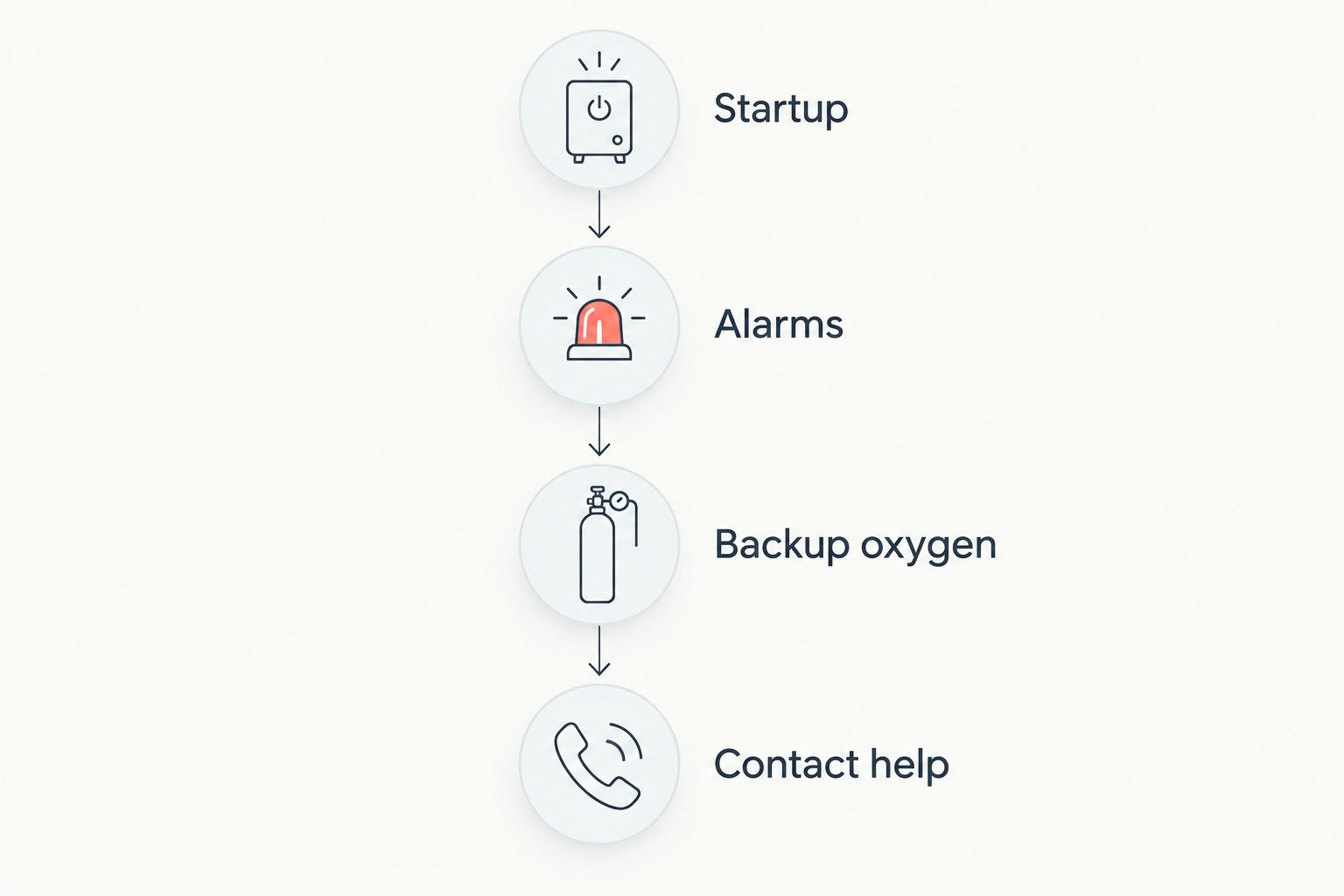
- Practice startup and shutdown using the manufacturer’s instructions.
- Learn each alarm’s meaning and the required response.
- Have the supplier demonstrate any backup oxygen equipment.
- Keep backup instructions where every caregiver can find them.
5. Inspect and clean equipment according to its instructions
Create a simple equipment log using paper or your phone. Record inspections, cleaning, filter work, and equipment problems. Use the actual manual to establish tasks and intervals; different components do not share one cleaning schedule.
Check the tubing and interface without changing the prescribed treatment. A kink, loose connection, or damaged component needs attention, but troubleshooting must not delay emergency help when the person has severe symptoms. Never open the concentrator housing or attempt internal repairs unless you are qualified and authorized.
Cleaning products also need compatibility checks. A disinfectant intended for an external surface is not automatically suitable for tubing interiors, patient-contact components, or every mask material.
- Inspect tubing for kinks, damage, disconnections, and trip hazards.
- Clean and replace patient-contact items according to their instructions.
- Follow the exact filter instructions for the concentrator model.
- Record alarms, recurring faults, and service conversations in the log.
6. Monitor the person, not just the display
Use the clinician’s monitoring plan rather than treating a pulse oximeter as an independent decision-maker. Pulse oximeters estimate oxygen saturation, and readings have limitations. Movement, poor circulation, nail products, and skin pigmentation can affect accuracy.
A number does not explain the cause of breathlessness or establish that treatment is adequate. Symptoms and the care plan remain essential. Do not increase oxygen flow simply to pursue a higher reading unless the prescribing clinician has provided explicit adjustment instructions.
During your 2026 care-plan review, check whether the written instructions still match current needs. Contact the clinical team about new or worsening symptoms. Call emergency services for severe breathing difficulty, blue or gray lips, chest pain, or sudden confusion rather than waiting for equipment troubleshooting.
- Record readings only as directed, alongside symptoms and activity.
- Follow the oximeter instructions for positioning and measurement.
- Use the clinician’s targets, not a universal internet threshold.
- Escalate concerning symptoms even when the display appears reassuring.
Compare concentrator options for home caregiving
The comparison below separates a capacity decision from a service decision. Choose equipment that meets the prescription, then confirm who supports it. Neither a larger flow rating nor an online listing replaces that process.
| Option | Best for | Practical advantage | Key limitation |
|---|---|---|---|
| Drive DeVilbiss 5 LPM Oxygen Concentrator | Caregivers whose patient’s prescription and technical requirements fit this exact model | A 5 LPM model to assess against the written prescription | Unsuitable when the prescribed requirements exceed the model’s capabilities; confirm all specifications |
| Drive DeVilbiss 10 LPM Oxygen Concentrator | Caregivers whose patient requires a compatible higher-flow concentrator | A 10 LPM model to discuss with the clinical team | Higher rated flow does not establish a clinical benefit or individual suitability |
| Clinician-coordinated oxygen equipment provider | Caregivers who need help arranging equipment and ongoing support | Lets you discuss setup, backup oxygen, training, and service together | The equipment and services provided depend on the individual arrangement |
The two concentrators below are equipment options, not treatment recommendations. Their listings do not establish which accessories are included or whether a particular patient can use them safely. Confirm those details before ordering.


Common mistakes home caregivers make
Treating higher flow as an upgrade
Choosing more capacity without checking the prescription confuses equipment capability with treatment need. Keep the prescribed setting unchanged and ask the clinical team to review any concern about inadequate oxygen delivery.
Assuming a purchase includes a complete care service
Equipment, clinical oversight, caregiver instruction, repairs, and backup oxygen are separate responsibilities. Before ordering from EWOT or another seller, identify who handles each responsibility and how you reach them outside normal hours.
Substituting a wellness mask or hose without checking
An accessory marketed for exercise, CPAP, or general wellness is not automatically suitable for prescribed oxygen. Confirm the interface, connectors, tubing requirements, and permitted length with the oxygen supplier; physical fit alone is insufficient.
Confusing oxygen training with medical oxygen treatment
Exercise with oxygen training and prescribed home oxygen serve different purposes. Do not replace a medical oxygen routine with a wellness session, add an exercise reservoir, or change delivery equipment without clinical approval.
Waiting for the next routine visit to report a problem
Recurring alarms, damaged tubing, new confusion, or worsening breathlessness need action under the care plan. Documenting a problem is useful, but documentation does not replace contacting the appropriate clinical or emergency service.
FAQ
What’s the best oxygen concentrator for a home caregiver?
The best oxygen concentrator is the exact model that meets the patient’s prescription and can be supported safely at home. Confirm flow, delivery mode, alarms, service responsibilities, and backup arrangements before choosing.
Is a 10 LPM oxygen concentrator better than a 5 LPM model?
A 10 LPM concentrator is not automatically better than a 5 LPM model. Select capacity according to the prescription and the exact model’s specifications, not an assumption that more oxygen is better.
Can I change the oxygen flow when my family member feels breathless?
Change oxygen flow only according to explicit instructions from the prescribing clinician. Follow the escalation plan for new or worsening breathlessness, and seek emergency help for severe symptoms.
What happens to a home oxygen concentrator during a power outage?
A mains-powered oxygen concentrator stops operating when its electrical supply fails. Arrange an appropriate backup oxygen plan with the clinical team and equipment supplier before an outage occurs.
Can I use an exercise oxygen mask for prescribed home oxygen?
Use an exercise oxygen mask for prescribed home oxygen only if the clinical team and equipment supplier confirm that exact configuration. A wellness accessory is not automatically a substitute for a prescribed oxygen interface.
How often should I clean a home oxygen concentrator?
Follow the manufacturer’s cleaning and maintenance instructions for the exact concentrator and its accessories. External surfaces, filters, tubing, and masks can have different requirements; do not apply one schedule to every component.
Can a pulse oximeter tell me whether oxygen treatment is working?
A pulse oximeter provides an estimate of oxygen saturation, not a complete assessment of treatment. Follow the clinician’s targets and consider symptoms, because measurement limitations can affect readings.
One last thing
The most useful final check is a caregiver handoff rehearsal. Ask another caregiver to locate the prescription, explain the alarm response, and describe the backup procedure without prompting. Fix any unclear instruction before leaving that person in charge.
Keep the updated 2026 care plan beside the equipment, not just on the primary caregiver’s phone. A concentrator is only one part of home oxygen care; the instructions must remain usable when the usual caregiver is unavailable.
